
EPISODE 152
The Application and Misapplication of
Evidence-based Practice:
Part 1 of 3 Episodes on Non-Speakers
and Gestalt Language Processing
Evidence-based Practice:
Part 1 of 3 Episodes on Non-Speakers
and Gestalt Language Processing
Play the Episode…
Show Notes
Barry is joined by Jess Teixeira, certified speech- language pathologist and a member of the Uniquely Human Podcast in defining and discussing the concept and practice of evidence-based practice (EBP). In particular, the discussion focuses on the application and misapplication of EBP specific to two issues of significance for autistic and neurodivergent individuals – approaches to support non-speakers, and therapy approaches for children who are gestalt language processors. This episode serves as the foundation for the two following episodes that address each of these issues in greater depth.
Check out the episodes on this special series.
Featuring
BARRY PRIZANT, Ph.D., CCC-SLP
Barry M. Prizant, PhD, CCC-SLP is recognized as among the world’s leading scholars on autism and as an innovator of respectful, person- and family-centered approaches, and is known internationally for his inspiring keynote addresses and presentations. He is Director of Childhood Communication Services, Adjunct Professor of Communicative Disorders at the University of Rhode Island, and has fifty years of experience as an international consultant and researcher. Barry has published five books, 150 articles/chapters, and is co-author of The SCERTS Model now being implemented internationally. He was a two-time featured presenter at the UN World Autism Awareness Day with more than 1000 presentations internationally. Barry’s book Uniquely Human: A Different Way of Seeing Autism (2022) is the best-selling book on autism since 2015, published in 26 languages and ranked by Book Authority as #1 of the “100 best books on autism of all time”. Barry co-hosts a podcast, Uniquely Human: The Podcast (www.uniquelyhuman.com) with his friend, Dave Finch, an autistic audio engineer. It is ranked # 1 of all time by Goodpods in categories of disability, psychiatry, autism, and ADHD.
Visit Barry’s website here
Visit SCERTS website here
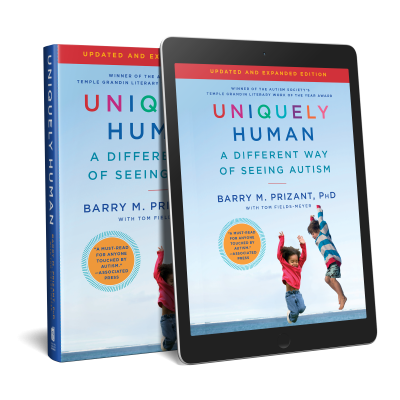
Uniquely Human, the book (Updated and Expanded edition!)

JESS TEIXEIRA
Jess Teixeira is a certified speech-language pathologist, international speaker, and the owner of Play Haven Pediatric Therapy. She specializes in supporting gestalt language processors and their families through direct services, consultation, and coaching for families and professionals. Jess regularly presents on echolalia, Natural Language Acquisition, and meaningful supports for gestalt language processors. Jess is a member of both the Meaningful Speech team and Uniquely Human Podcast teams. Her work centers on listening to lived experience and applying that to real-world clinical practice in ways that feel accessible and practical. Jess is deeply passionate about shifting the field away from compliance-based models and toward approaches that prioritize connection and autonomy.
Uniquely Human: The Podcast
EPISODE 152 – FEB 27th. 2026
EVIDENCE-BASED PRACTICE: PART 1 OF 3 EPISODES ON NON-SPEAKERS AND GESTALT LANGUAGE PROCESSING
🎙️ Transcript and Audio Usage Disclaimer
© 2026 Uniquely Human: The Podcast. All Rights Reserved.
The contents of this podcast, including all audio recordings, transcripts, and related materials, are the intellectual property of Uniquely Human: The Podcast and its fiscal sponsor, Community Autism Resources, a registered 501(c)(3) nonprofit organization.
These materials are provided solely for personal, educational, and non-commercial use.
No portion of the podcast audio, transcript, or any derivative materials may be reproduced, redistributed, modified, or publicly displayed without prior written consent from Uniquely Human: The Podcast or its authorized representatives.
Transcripts are provided for accessibility and reference purposes. They may contain minor transcription or formatting errors. When quoting or referencing the podcast, please credit Uniquely Human: The Podcast and provide a link to the original episode page.
By accessing or downloading transcripts, you agree to comply with this usage policy and acknowledge that all copyrights, trademarks, and intellectual property rights remain the exclusive property of Uniquely Human: The Podcast and its creators.
For permissions or inquiries, please contact:
📧 uniquelyhumanpodcast@gmail.com
Trilogy Announcement
[00:00:00] Barry: Hi, this is Barry and I’m here to share with you a special trio or triptych of episodes on Uniquely Human: The Podcast that’s coming up. Why are we doing a special trio of episodes? We’re gonna be addressing areas that I’ve been involved in clinically as well as in research, as well as my lived experience in relationships with autistic and other neurodivergent individuals and their families.
These areas include approaches to support communication in nons speakers, gestalt language processing issues in autistic individuals, and their relationship to Gestalt cognition, and finally, evidence-based practice. In all cases, I’ve published and presented at conferences, going back to my dissertation in the 1970s on Echolalia, and to the 1980s in the case of approaches to support non speakers.
This trio of episodes is long overdue as a number of critics have arisen, and they’ve not been challenged in any comprehensive manner, even though their arguments are poorly supported, and their recommendations violate the basic tenets of evidence-based practice, both in clinical fields and what we understand about evidence-based practice even in medicine. Interestingly, there’s great overlap in the individuals who are critics. Many people refer to them as naysayers. They’ve been most involved in challenging not only the findings of the work that I’ve done with colleagues, but decades of research, clinical practice, and lived experience. By the way, we will identify who they are in the upcoming episodes.
So in these three episodes, the linchpin is evidence-based practice, how critics have misapplied and indeed seem to violate our basic understanding of how evidence-based practice is defined. And accepted by major clinical organizations. They also dismiss any research that is not analytic and experimental, even though such traditions are not as relevant to the most important clinical questions that are being posed.
Meet the Guests
[00:02:12] Barry: So let’s set the stage for you. The first episode, I will be joined by Jess Teixeira, who is a credentialed speech and language pathologist. Who works on a daily basis with families and young children who are Gestalt language processors. Her work navigates between evidence-based practice, clinical decision making, and everyday experience with families.
In the second episode, I will be joined by David Kaufer, who is a parent who’s navigating these issues in systems and who’s raised a son and has experienced firsthand. The impact of success of spelling with his non-speaking son. He also has researched and debunked many of the claims of the naysayers in a series of articles on Substack.
And finally in our third episode, we’ll be joined by Dr. Jamie Hoerricks, who’s a brilliant autistic self-advocate, a public school educator and a Gestalt processor. She’s a prolific author who writes extensively about her experiences. Each of these individuals and our guests shows a different but complimentary evidence stream, published research, experiential clinical experience, parent perspectives, and also lived experience.
Why Evidence Matters
[00:03:31] Barry: So we will be arguing throughout that evidence-based practice when practiced fully. Includes lived experience as essential evidence, and that an overdependence on narrow quantitative research or absence of narrow quantitative research judges evidence only within traditional boundaries and perpetuates systemic exclusion of marginalized populations.
We will argue throughout that the burden of proof must be adjusted when dealing with marginalized communication modalities, different ways of thinking. As Dr. Hoerricks says, why do we need to prove anything to you at all? This is the lived experience. It’s my lived experience, and it’s the lived experience of many people who are non speakers and people who know them well.
One other quote that she says, which is so relevant to this, is that knowledge is something you live with. It is not something you extract and display. So we will now move ahead with episode number one. Evidence-based practice and, I will be joined by Jess Tera, hope you hang on and enjoy what we have to say and more importantly, use what we have to say in pushing back against so much misinformation that is out there.
Show Intro and Jess Joins
[00:04:55] UHP: The primary purpose of Uniquely Human: The Podcast is to educate and inform the views expressed during all episodes are solely those of the individuals involved and do not constitute educational or medical advice. Listeners should consult with professionals familiar with each individual, or family for specific guidance.
Uniquely Human: The Podcast is produced by Elevated Studio. Music is graciously provided by Matt Savage of Savage Records.
[00:05:34] Barry: Hi, I’m Dr. Barry Prizant, clinical scholar, researcher and consultant on Autism and Neurodiversity, and a Brooklyn boy raised in the big city.
[00:05:45] Dave: And I’m Dave. I’m none of those things, and I grew up on a farm in Illinois. But being on the spectrum myself, I have plenty of personal insight to lend
[00:05:54] Barry: and this is Uniquely Human: The Podcast, a show that illuminates and celebrates autism and neurodiversity.
Today on Uniquely Human: The Podcast, I’m thrilled to be joined by Jess Teixeira, discussing some very important issues. Jess, you are a special guest today, so welcome.
[00:06:24] Jess: Thank you.
[00:06:26] Barry: Few things about Jess before we get started. Jess is a certified speech language pathologist and international speaker and the owner of Play Haven Pediatric Therapy.
She specializes in supporting Gestalt language processors and their families through direct services consultation and coaching for families and professionals. Jess regularly presents on Echo natural language acquisition and meaningful supports for Gestalt language processors. She is a member of both the Meaningful Speech Team and the Uniquely Human podcast team.
She’s a very valued member of our team. Her work centers on listening to lived experience and applying that to real world clinical practice in ways that feel accessible and practical. Jess is deeply passionate about shifting the field away from compliance-based models and towards approaches that prioritize connection and autonomy me.
Families Feel Dismissed
[00:07:25] Barry: So let me just share with all listeners that, Doing this podcast and some follow up episodes has long been our agenda, and we feel it’s a very important conversation. so Jess, why do you feel it’s an important conversation?
[00:07:44] Jess: From supporting Gestalt language processors for now the past four years, this is something that’s come up time and time again, working with families, consulting with professionals. And it’s a topic like Barry said, that we’ve wanted to dive into and it’s extremely important.
[00:08:05] Barry: Yeah. And certainly for me as we approach the topic of evidence-based practice, we’re specifically from the non-speaking and minimally speaking community, it has always been an issue that I felt we needed to address because we feel there’s a lot of misinformation out there about evidence-based practice. And so we’re gonna do a little bit of a deeper dive into that today. In the way we discuss, what is evidence-based practice? How is it intended to work? and more importantly, how it’s being misunderstood and being misapplied and, critiques of both spelling and typing approaches as well as geal language processors.
Now Jess, you have a lot of direct experience on an ongoing basis supporting families as we’ve mentioned. So why do you feel it’s important to address this issue from your experience?
[00:09:07] Jess: I think because families feel confused. They feel dismissed. They don’t feel heard when they’re bringing these lived experiences to professionals and they’re not getting.
The feedback that they might expect or they’re getting shut down, by these professionals that they go to, and I think it’s extremely important that we bring this topic up for that reason.
[00:09:35] Barry: Yeah, I think one of the things that I have heard in my whole career from parents is that the most important thing for them in terms of developing trust with professionals is feeling that they’re being heard.
Is feeling that they are entering a partnership and not a situation where they’re being dictated to. So has that actually happened when, you speak to parents, when they say, for example, this helps me understand who my child is, the way he or she processes language. What do parents say?
[00:10:16] Jess: I have had many experiences where parents come to me, whether it’s a parent that I’m working with directly one-on-one, or a parent that I am working with one time consultation where they say, I, I learned about this and I brought it to a professional, and I started applying these strategies and I told them that this worked and how I’ve seen such, this positive progress and connection with my child.
And in return they got potentially negative or, just, responses that they weren’t expecting or responses where they said, you might feel that way, but we, shouldn’t be doing this, for example. and they just feel dismissed. They, feel that their experiences. Were dismissed or their, gut feelings or whatever it might be, were dismissed.
[00:11:13] Barry: Yeah. And, not only is that happening on the close in clinical and educational contact with families, but it’s also being spread as the gospel, if you will. At professional conventions where, certainly people in our field are hearing what you should do and what you should not do, and what is evidence-based and what is not evidence-based, which really leads us to some of the meat of evidence-based practice that we really wanna dig into right now.
Three Pillars Explained
[00:11:51] Barry: So I’ve heard you speak, Jess, about the three equal pillars of evidence-based practice. You wanna just, tell us what those are and then we’ll do a little bit of a deeper dive?
[00:12:02] Jess: Yeah. So the three pillars of evidence-based practice include research, evidence, clinical expertise, and client and family values, perspectives and priorities.
And that’s directly from ASHA.
[00:12:15] Barry: Yeah. So as a matter of fact, since you said directly from ASHA, let’s read the ASHA definition. The most recent, definition of evidence-based practice according the Ameri, according to the American Speech Language Hearing Association, and let me say upfront, very consistent with that of the American Psychological Association, the Institute on Medicine, we’re not gonna read all of those for you right now, but this is from ASHA, and that’s number one. The pillars of evidence-based practice include clinical expertise and expert opinion, and this is verbatim, and that includes the knowledge, judgment, and critical reasoning acquired through professional training and experiences.
Number two, the actual evidence, both external and internal evidence. And this includes the best available information gathered from the scientific literature. That is considered to be the external evidence, and from data and observations collected on an individual client. And that would be what not only the clinicians collect, but in many cases parents are involved in collecting that directly.
And then finally, client, patient, and caregiver perspectives. The unique set of personal and cultural circumstances, values, priorities, and expectations identified by a client and their caregivers. So that is according to ASHA. And what they go on to say is. Why don’t you take that, Jess?
[00:13:58] Jess: Sure. So they go on to say, when all three components of evidence-based practice are considered together, clinicians can make informed evidence-based decisions and provide high quality services reflecting the interests, values, needs, and choices of individuals with communication disorders.
[00:14:17] Barry: Yes, absolutely.
[00:14:18] Jess: Close out that definition
[00:14:20] Barry: and that’s pretty clear.
Misuse by Critics
[00:14:22] Barry: So now we’re going to get into both the use and application of this definition of evidence-based practice as well as the misuse. Because a claim that we are trying to get across today at the beginning is that for many of the critics of both approaches for nons speakers, as well as approaches for Gestalt language processors, that in many cases they are misusing.
The definition of evidence-based practice. Let’s do a little bit of turn taking here, some good communication strategies and, move ahead. And some of this is adapted from an article I actually published close to 15 years ago on the, use and misuse of evidence-based practice, but it’s updated somewhat.
So I will take the side of the appropriate application of evidence-based practice. And Jess will then comment on, unfortunately, how it has been misapplied, especially relative to nons speakers and, gestalt language processing. Number one, the appropriate use is that broader sources of evidence are taken into, account. And very often it involves collaborative approaches from many individuals. It could be therapists, educators, in some cases, the person themselves, as well as parents to inform practice.
[00:15:57] Jess: And so on the other hand, if evidence-based practice practices misused or misinterpreted, it would be a narrow or limited or hierarchical application of evidence. And where evidence is not treated equally, it’s not treated equally to clinical expertise or client perspective, and it’s treated as greater than those other two things. When, as we had just read from the ASHA definition, these things are all equal evidence is not greater than the other two.
[00:16:30] Barry: So, to dig a little bit deeper, in the appropriate use, certainly peer reviewed published research is one source, but it is not the only source. And in many cases it’s not necessarily what you said at the top of a hierarchy of what is best.
[00:16:52] Jess: Exactly.
[00:16:53] Barry: How is it being applied though inappropriately?
[00:16:57] Jess: So critics of nons speakers or desalt language processing are saying that there is no evidence at all. That is not evidence-based. And they’re saying that is because there is no evidence, there’s no research evidence is what they’re saying when that actually is not the case.
There has been research since the seventies of the eighties that exists. From Barry himself and from others. And so there’s research that either is not being included in these reviews. It’s not being mentioned to parents. It’s not being considered as worthy of evidence. And then also they’re not taking into account clinical expertise.
These clinicians that are working with these clients, working directly with these families, listening to lived experiences, listening to self-advocates that are, have come forward and said, this is exactly how I develop language. These are the things that I, that worked for me and helped me make progress.
And clinicians that are taking data day to day and looking at these patterns across their clients and what’s working and what isn’t working. And they’re, solely looking at research.
[00:18:17] Barry: Yeah. I think it’s appropriate to mention now that both for the GLP community as well as the non-speaking community, we are now talking about probably hundreds of educators and clinicians and thousands.
Of families and individuals. So when you say very often their voices are not being heard, we’re not talking about a dozen or 15, or 20. We’re talking about huge communities, and I can certainly speak to that from my own experience. I was a presenter at a conference, A year and a half ago during the summer on non speakers. It was sold out 600 people. It involved probably one third family members, one third professionals of all stripes and colors, and one third nons speakers who type and spell. So we’re talking about huge communities now and let me just toss in there. Whereas the critics tend to be a very small relative group that has pretty much dominated the airwaves with what they’ve put out there for a number of years now.
[00:19:26] Jess: I was just going to add, I have the same experience. I have the same experience internationally presenting to groups with, that included parents, included, caregivers included, professionals included, all kinds of people, that are supporting nons speakers, control language processors.
And so just wanna further emphasize your point, like we’re not, talking about just this small group. This is based on talking and consulting with many people.
Empty Reviews and Innovation
[00:19:53] Barry: Yes, so, here there’s an important concept in research, and that is called empty reviews. That if you go ahead and you try to seek out research on a topic and you can’t find, at least by the very, in this case, the very narrow criteria that are set for acceptable research by the critics. If you can’t find any research, then you shouldn’t be doing this, or you should be extremely cautious. Okay. And part of that is also, a part of the as Asher position statement on, spelling and typing and other approaches. Yet one of the critics of non speakers, Ralph Schlosser, who’s a professor at Northeastern, has published about empty reviews in a 2009 article. And he and his colleague, Jeff Sifu, actually have said empty reviews should not be used to prohibit clinical practice. That it doesn’t mean that approaches may not be effective. It just points to the need for more and varied research on the topic. Again, we wanna emphasize there is research that’s been done, especially, around gestalt language processing, but also for nons speakers.
But. A lot of the evidence is qualitative, and that’s not accepted by the critics. So I just said what the narrow application is. But if you wanna reiterate that.
[00:21:30] Jess: They’re saying, if research doesn’t exist yet, then practice is prohibited. We should not be doing this. And it, they’re, using that reason.
Going way back to talking about parents, right? When parents are bringing this up, they’re saying, it’s not evidence-based. We shouldn’t use that. Let’s, let’s move on to these other things, and just dismissing that.
[00:21:52] Barry: and also an extension of that is if research doesn’t exist according to very narrow criteria, parents should be told this approach is not effective, which is not the case.
Exactly. A, lack of research doesn’t necessarily mean that approach is not effective. And we of course can go back to even the beginnings of augmentative communication, commonly used approaches such as social stories, a lot of techniques for supporting emotional regulation. At the get go in terms of their application, they were not yet evidence-based according to experimental research criteria, but many of those have become evidence-based approaches according to those criteria.
[00:22:41] Jess: We would have no advances if that was the case.
[00:22:44] Barry: That’s what supports innovation and emerging promising practices, and it’s very important to say that. Now, I do wanna toss in into our discussion right now, is there have been claims that in both cases with nons speakers as well as with GLP, that it causes damage or it’s harmful. And I will say that certainly in the early days, regarding the research on non speakers, there were, there is evidence or there was evidence of nons speakers communicating such things as being abused. That were not born out and there were negative consequences, but that was a whole different era in terms of the application of approaches.
And not only that, but in the real world, if a claim is being made of a person being harmed in any way, there would need to be other evidence of that, that you wouldn’t just take it from what a person says or what a person types. So that is not really a substantial argument. And against that argument.
What about the incredible benefits that are reported and often ignored?
[00:23:59] Jess: Absolutely. Absolutely. Yeah. We’re not saying that we shouldn’t look further into these things, right? That’s not what we’re claiming. But to just completely dismiss it for those reasons in the past, Would be a misuse.
Misuse of. Yeah,
[00:24:18] Barry: absolutely. there actually is a quote from an article on evidence-based practice that says a lack of evidence is not evidence of a lack of effectiveness. Okay. And therefore, let’s just put an asterisk on this point. An empty review does not automatically justify banning a practice.
Okay. And. This is important because that is one of the major arguments that’s made by critics.
[00:24:51] Jess: Absolutely. That’s what I see time and time again in, in these articles and things that are coming out. And based on that right there and what we’re talking about, they, they say the opposite, yeah.
[00:25:07] Barry: Yeah.
Individualized Care and Lived Experience
[00:25:08] Barry: And, there are some other points about why this. Distinction matters right now in terms of appropriate use of evidence-based practice re, which really does look at individual differences, looks at multiple sources of information about whether an approach is helpful, whether improves quality of life.
There also is another important fact, and when we look at appropriate use of evidence-based practice that really supports looking at individual differences and multiple sources of information. And that is autism and neurodivergent conditions are heterogeneous, that individual approaches are needed.
And since you are an expert in kids who have gestalt language processors, do you wish to comment on that, even regarding kids who fall under that category?
[00:25:59] Jess: Yeah, when I’m doing, for example, Trainings or talking to many clinicians or when I’m working on parents one-on-one, I’m always recommending an individualized approach where I’m always saying, I’m not taking this and applying the same thing to every single client or child or adult language processor I support.
Each child is different. And so we, can’t, we need to be taking individualized approaches for that reason.
[00:26:32] Barry: Absolutely.
When we talk about individualized approaches, and we talk about using qualitative evidence as well, And this is, my perception, our listeners can agree or disagree with this, but I’ve been in the field for quite a while. Okay. More than half a century. And I truly believe, at least in my growth, excuse me, as a professional, that our deepest and most accurate understanding of autism and neurodivergent conditions has come in the last 10, 15, 20 years from self-advocates talking about their individual experiences far more than.
Experimental research when it comes to the kinds of approaches that support people and support our understanding of the autistic experience. And as a matter of fact, as neurodivergent and autistic people have really gained the bully pule too, to some extent, it’s overturned so many myths that research supported for many, years.
[00:27:44] Jess: So many. I have learned so much from consulting and working with adult geal language processors, for example, in my practice, since that’s what I specialize in. so many things from what I learned, for example, back in grad school or back in my clinical fellowship and things that have changed since then from just what I’ve learned from them is huge.
Huge. And what I see day in and day out in the field are changes for because of them.
[00:28:19] Barry: And you raised such an important point. You are saying, I am learning from my clients. Yeah. I am learning from my families. In contrast to what the critics say is as an expert, I’m going to tell you what is right. Okay.
And so often we’re not seeing that openness to learning. We’re not seeing a willingness to meet, for example, with nons speakers. We’re not seeing clinicians who have their own lived experience with these populations, which in and of itself should invalidate what they wish to say.
Expert vs Collaborative Model
[00:28:59] Barry: So this does align with what has been referred to as an expert model versus a collaborative model.
So let’s talk about that a little bit, and I’m going to play the side of when a professional or a researcher is engaging in the role of an expert model, what that looks like. And then maybe you could talk about the collaborative side of that as well. Okay.
[00:29:27] Jess: Let’s do it.
[00:29:27] Barry: So the expert model side is, I am the authority.
Okay. And even if parents say something that they strongly believe through their experience about their child or family member, I need to tell ’em they’re wrong. Okay. I need to tell ’em, you probably shouldn’t be doing what you’re saying here because in my opinion, that’s not helpful. Okay. And that goes for dismissing clinicians who have different beliefs.
As well as a whole community. ”Cause in both cases we’re talking about the autistic community really having major issues in what’s being said about them and the way they learn and the way they communicate.
[00:30:17] Jess: Yep. And then through a collaborative model, it would be centering. Parent expertise, parents are the experts on their children and taking that into account and how can we collaboratively, work together with what you do know about your child, what you do see and what you do experience with your child, And take that and create shared goals again, collaboratively together.
And this is foundational in pediatrics, mental health, early intervention. This is family centered. We’re centering the families and we’re working together with families for a common goal, Which is in the best interest of that child.
[00:31:02] Barry: Absolutely. So rather than making decisions for families, what you’re saying is it’s the obligation under evidence-based practice to make decisions with family.
[00:31:16] Jess: Exactly, and the clients themself, themselves, right? So we want to include them, if we can. We wanna include them. We want them to be part of goal setting and decision making and sharing their experience and what they feel is helpful or what they wanna work on, as well.
[00:31:37] Barry: Absolutely. It’s called, self-determination, Yep,
[00:31:41] Jess: exactly Right.
[00:31:42] Barry: Yeah. That actually brings me to a, definition that I composed a number of years ago in a published article on what Family-Centered Practice is, and it’s from an article that I wrote called Treatment Options and Parent Choice, and here’s the definition. Family-Centered Practice has as its primary goal, empowering families with the knowledge and skills to make the best choices for their child and for the family.
Family centered practice professionals collaborate with families in decision making about specific goals and objectives, as well as educational treatment approaches. Parents are respected as experts regarding their child or family member. And professionals consider each family’s unique strengths and needs as well as its cultural and religious values.
And we could just use the term person centered practice and plug that in, terms of family centered practice. And the same points and values in practice would hold up. Yeah.
[00:32:48] Jess: Absolutely.
Family Centered Practice in Action
[00:32:52] Barry: Let’s talk a little bit about. You’ll work with families again, I know you, you’ve already commented on that, but that’s what you do.
Your work is primarily it. It’s not taking the child and bringing them into a therapy room and asking the parents to sit in the waiting room. You are working in essence as a guide, And helping the parents discover what in some cases, what they already know. But in other cases, what would be helpful?
Supporting their child’s development. So feel free to comment on your experience.
[00:33:29] Jess: Absolutely. From the start, this is something that I want parents to feel when they work for me. I want them to feel empowered, feel like they are the experts. So like from that initial contact with parents, I am telling them, you know your child best. You tell me what is working, what are the goals for your child and how I can support you, right? Because they are with their child much more than I am. They, like we said, are experts on their child. I am there to support them collaboratively and together in doing so. And to your point where you said, These clients aren’t coming to a therapy room and their parents are sitting out in the waiting room and then I go in. Drop them off and they leave. And no, I am saying to parents, you are just as much a part of this. I invite them into sessions. I have the luxury of seeing clients in their homes and I am encouraging parents to be a part of these sessions if they can, encouraging them. I even include parents in goals sometimes because they’re so important to supporting my client. So I do whatever I can to make them feel an equal part, rather than feeling that I am the expert coming in and telling them, you need to do this. Here’s, what is right, here’s what is wrong. But I’m, trying to encourage collaboration from the start.
[00:35:11] Barry: Yeah. And, when that happens, parents feel ownership of the progress they see. In many cases, it supports their intuitions because unfortunately, what happens in so many cases, when you have critics of something that parents feel is helpful, it makes them question their own intuitions about their child.
And I think that’s one of the worst things that could happen to a parent. Yeah, Is if somebody says no, what you’re doing is not right or even harmful. And that’s really a shame when that happens.
[00:35:46] Jess: I have parents that come to me and they’ll say from the start, here’s what I’m seeing, but I’ve been told that’s not right. Or here’s things that I’ve wanted to do in the past, but I’ve been advised against doing that, or I’ve been doing things that have really never felt right. And then I came across your work and I started learning more and it just, it really felt like everything in my gut that I should be doing to support my child, That I’ve been advised against.
[00:36:16] Barry: Yes. And, just to be clear, does that mean that we never say to a parent, oh, I notice that when you ask too many questions in a row, your child gets a little bit stressed. Maybe we ought to comment more, rather than asking lots of questions. It do it, it doesn’t mean that we don’t give guidance.
That could be helpful. And maybe pointing out to a parent, I’m observing that may not be as helpful as you hoped it would be. So I just wanna be clear on that.
[00:36:54] Jess: Yeah. And turning it around to them. I’m noticing when you ask a lot of questions, maybe that’s not the most helpful. Have you noticed that when you try commenting, there’s more connection with your child or there’s more language with your child, right?
Turning it back and getting their feedback on that too, right? You can give suggestions and get their feedback, and often parents are seeing the same things we are, but you might just have to give that feedback to get to that point.
[00:37:19] Barry: Yes.
NIH Community Partnership
[00:37:21] Barry: So I think it’s important to point out, this is not just Barry’s and Jess’s opinion here in, in reference specifically to making sure that we’re hearing people from the community, as a matter of fact, the National Institutes of Health came out with a specific directive. So in its latest autism data science initiative, which is also known as the ADSI, NIH stated quote, each ADSI research team will work in partnership with the autism community to help shape the direction of the research. And so even at the highest levels of experimental research, it is now recognized that we’re really not addressing the issues fully informed or in a fully informed way unless we have the autism community involved in some cases, as the researchers themselves or consulting to the research teams. Yet the critics of both approaches for nons speakers as well as Gestalt language processing, have intentionally not only dismissed what the neurodivergent community says, but when given opportunities to interact with members of the neurodivergent community, they refuse to do so.
[00:38:53] Jess: Yeah. Yeah. And if them, if self-advocates themself or families. Absolutely. And if families and autistic people across cultures are telling us something is helping them or helping their child directly, that is evident.
And so to not work with them, to not include them, to not speak with them at all, that is blatant misapplication of evidence-based practice and quality research.
Next Episodes Preview
[00:39:23] Barry: Let me just, give you a little bit of a preview. In the sense that we will be following up with additional episodes where we’re going to dig into more specifically, the misunderstanding and misapplication of evidence-based practice as it pertains to the non-speaking and minimally speaking community, as well as gestalt language processors.
At this point, what we could leave you with is a little bit of an idea. What we are going to, address down the line. And the first thing is, taking a deeper dive into what critics say and talking about how they say it and who says what about nons speakers in Gestalt language processors. And so we will hear from people who are actually being spoken about by the critics, and what their experiences have been also when appropriate from parents as well. And to be quite blunt, what we’re going to do is identify the hypocrisy we often see, and that is that very often what the critics are criticizing regarding nons speakers and the gestalt language processing community.
They have said things in the past that directly contradict their criticisms regarding their own practices. Okay. We’re gonna talk about a lack of understanding of some of the basic core issues, such as the neuromotor impairments that are often seen, that could help explain why so many non-speaking people who are neurodivergent very often are not able to speak. But benefit from other approaches to communication, even with support. Because we all need support in communicating. It’s part of the development. Of course, we’re gonna get back to the violation of the basic issues of evidence-based practice.
And a question that we often get, maybe, Jess, you wanna talk about this question a little bit that both of us get all the time relative to these two different communities.
[00:41:42] Jess: Yeah. Why? Why is there pushback? W why are they saying these things? That’s the question that I get time and time again.
[00:41:51] Barry: Yeah.
[00:41:52] Jess: And so we’re hoping to address why that might be, or why we think that might be.
[00:41:57] Barry: Yes. And, we get it both from the professional community as well as from Joe and Susie off the street. When I explain to people who are not in the field in any way, about this issue and they say, why would anybody push back against that? And then sometimes we have to do a deeper dive into their arguments and how their arguments are invalid.
Jess, thank you. I think this is a good start and I look forward to future episodes.
[00:42:30] Jess: I’m looking forward to it. Thanks for having me.
…and Continue the Discussion
Do you have a book or podcast club? If so, you may use this discussion guide to facilitate a conversation about this episode.
1. What are three major takeaways for you after listening to Barry and Jess discuss evidence based practice?
2. What themes about EBP did Barry and Jess highlight which have been most meaningful to you in your lived experience as a parent, professional or neurodivergent person who have a relationship with a non-speaker or gestalt language processor?
3. How do you intend to apply information? Discussed in this episode in supporting non-speakers or gestalt language processors?
HOSTED BY

Barry Prizant, Ph.D., CCC-SLP
Dr. Barry Prizant is a speech-language pathologist with more than 50 years experience as a researcher and international consultant for autistic and neurodivergent individuals and their families. He is an Adjunct Professor of Communicative Disorders at the University of Rhode Island and Director, Childhood Communication Services (a private practice). Previously, he served as Associate Professor in the Department of Psychiatry in the Brown University School of Medicine, and held a tenured professor appointment at Emerson College. Publications include 5 books, most notably Uniquely Human: A Different Way of Seeing Autism (2015; 2022) and The SCERTS Model manuals, an educational approach implemented in more than a dozen countries. He has published 150 scholarly chapters and articles and serves on numerous professional advisory boards for journals and professional organizations. Barry has presented more than 1000 seminars and keynote addresses internationally, including two invited presentations at the United Nations for World Autism Awareness Day. His career contributions have been recognized with honors from Brown and Princeton Universities, the Autism Society of America and the American Speech-Language-Hearing Association.
Visit Barry’s website here
Uniquely Human, the book (Updated and Expanded edition!)
Dave Finch
Dave Finch is the author of the New York Times bestselling memoir, The Journal of Best Practices: A Memoir of Marriage, Asperger Syndrome, and One Man’s Quest to Be a Better Husband. As a writer and creative consultant, his work has appeared on ABC, CBS, NBC, CNN, NPR, SiriusXM, The New York Times, Rolling Stone, The Howard Stern Show, and the award-winning Netflix series, Atypical. Based in Denver, Dave’s company, Elevated Studio, produces this podcast and other recognized series.
Visit Dave’s website here
“I have read a million and one books on Autism. Uniquely Human is the best book I have ever read, hands down. Thank you Barry for this incredible gift!!!!”
– Navah Paskovitz, Mother of three boys with Autism, Co-Founder, the Ed Asner Family Center
“Compassion, learning and supportive strategies–the three essentials for working with folks with ASD–are an integral part of this must-read book.”
– Michelle Garcia Winner, Speech Language Pathologist and Founder of Social Thinking
“Thanks be to Barry for the first-ever must read written for parents, educators, and clinicians.”
– Michael John Carley, Founder, GRASP; Author of Asperger’s From the Inside-Out
“What makes the book compelling is how funny Mr. Finch is about himself. He’s great company.”
– Susannah Meadows, The New York Times
“In this hilarious memoir (which also gives some of the finest explications of Asperger’s out there), Finch approaches trying to be a better husband and father with the determination of Sherman marching on Atlanta.”
– Judith Newman, People (4/4 stars)
“Talk about being on a roll. This dude wrote a book, he has Asperger’s syndrome. He cured himself by listening to me on the radio!”
– Howard Stern