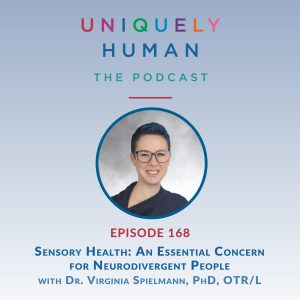
EPISODE 168
Sensory Health:
An Essential Concern for Neurodivergent People
with Dr. Virginia Spielmann, PhD, OTR/L
An Essential Concern for Neurodivergent People
with Dr. Virginia Spielmann, PhD, OTR/L
Play the Episode…
Show Notes
Dr. Virginia Spielmann discusses sensory health and its broader implications with Barry and Dave, beyond just auditory or visual sensitivity issues. She explains how sensory processing affects emotional and physical well-being, emphasizing that everyone processes sensations constantly but may experience challenges in how they integrate sensory information. She explains how neurodivergent individuals often face misinterpretation of their behaviors, with observable actions being labeled as “just behavior” rather than recognized as potential indicators of sensory distress. Virginia concludes by emphasizing that sensory health is a human issue affecting everyone, not just those with neurodivergent conditions, and highlights how differences in sensory processing have contributed to human diversity and expertise throughout history.
Featuring

Dr. Virginia Spielmann
Dr. Virginia Spielmann is an AUDHD Occupational Therapist and the Executive Director of the STAR Institute for Sensory Processing in Denver, Colorado. She is a published author of multiple papers and chapters. She is an international and TEDx speaker. She consults on television and other media projects. Virginia obtained her PhD in Infant and Early Childhood Development with an emphasis on mental health from Fielding Graduate University in Santa Barbara. She also is trained as a DIR/Floortime therapist.
Learn more about the STAR Institute for Sensory Processing
Uniquely Human: The Podcast
EPISODE 168
SENSORY HEALTH:
AN ESSENTIAL CONCERN FOR NEURODIVERGENT PEOPLE
A DISCUSSION WITH DR. VIRGINIA SPIELMANN
🎤 Transcript and Audio Usage Disclaimer
© Uniquely Human: The Podcast. All Rights Reserved.
The contents of this podcast, including all audio recordings, transcripts, and related materials, are the intellectual property of Uniquely Human: The Podcast and its fiscal sponsor, Community Autism Resources, a registered 501(c)(3) nonprofit organization.
These materials are provided solely for personal, educational, and non-commercial use.
No portion of the podcast audio, transcript, or any derivative materials may be reproduced, redistributed, modified, or publicly displayed without prior written consent from Uniquely Human: The Podcast or its authorized representatives.
Transcripts are provided for accessibility and reference purposes. They may contain minor transcription or formatting errors. When quoting or referencing the podcast, please credit Uniquely Human: The Podcast and provide a link to the original episode page.
By accessing or downloading transcripts, you agree to comply with this usage policy and acknowledge that all copyrights, trademarks, and intellectual property rights remain the exclusive property of Uniquely Human: The Podcast and its creators.
For permissions or inquiries, please contact:
📧 uniquelyhumanpodcast@gmail.com
Podcast Disclaimer
[00:00:00] UHP: The primary purpose of Uniquely Human: The Podcast is to educate and inform. The views expressed during all episodes are solely those of the individuals involved and do not constitute educational or medical advice. Listeners should consult with professionals familiar with each individual or family for specific guidance. Uniquely Human: The Podcast is produced by Elevated Studio. Music is graciously provided by Matt Savage of Savage Records.
Meet The Hosts
[00:00:39] Barry: Hi, I’m Dr. Barry Prizant, clinical scholar, researcher, and consultant on autism and neurodiversity, and a Brooklyn boy raised in the big city.
[00:00:49] Dave: And I’m Dave. I’m none of those things, and I grew up on a farm in Illinois. But being on the spectrum myself, I have plenty of personal insight to lend.
[00:00:59] Barry: And this is Uniquely Human: The Podcast, a show that illuminates and celebrates autism and neurodiversity.
Introducing Virginia Spielmann
[00:01:14] Barry: Today on Uniquely Human: The Podcast, we will be addressing an issue of vital importance, and we have the right person for it — Dr. Virginia Spielmann. Virginia, welcome to our podcast.
[00:01:29] Virginia: Thank you so much for having me.
[00:01:31] Barry: It is really a pleasure to have you. Virginia is an AuDHD occupational therapist and the executive director of the STAR Institute for Sensory Processing in Denver, Colorado. Dave, what do you know about that?
[00:01:50] Dave: Well, I’m not too far away — I’m located in Colorado myself, just south of Denver.
[00:01:56] Virginia: We must be pretty close. I’ll have to take you up on a visit.
[00:02:02] Dave: As long as it’s gluten-free, I’ll get you a sandwich.
[00:02:05] Virginia: As long as it’s gluten-free, it’ll be great.
[00:02:08] Barry: Virginia is a published author of multiple papers and chapters, an international and TEDx speaker, and she consults on television and other media projects. She obtained her PhD in infant and early childhood development with an emphasis on mental health from Fielding Graduate University in Santa Barbara, and she is trained as a DIR/Floortime therapist. Something our listeners may not know: in the ’90s I worked with Dr. Stanley Greenspan for about five years.
[00:02:47] Virginia: I did know that actually. I’m very jealous — what a great experience.
[00:02:52] Barry: It absolutely was. So we are cousins in a sense.
[00:02:56] Virginia: I love it.
What Sensory Health Means
[00:02:58] Barry: Sensory health has become such an important area, and you’ve become such an important spokesperson around it. So many of us think about sensory issues as being hypersensitive or hyposensitive — but you talk about sensory health in a much broader way. Could you share how differences in sensory processing affect a person both emotionally and physically?
[00:03:35] Virginia: It’s a good place to start by reminding ourselves that everybody is processing and integrating sensation all the time. That’s how you make sense and meaning, and then navigate the world with agency on your own terms. This is happening even while we’re sleeping. Think about waking up this morning — could you feel the sheets twisted around your legs? Could you smell coffee, if you’re lucky like me and it gets delivered by your partner? Could you feel the warmth of sunlight on your face? Could you hear sounds from your immediate space, then other rooms, then outside? If you hear the trash truck on Friday morning before you’ve put the bin out, it tells you immediately that you’re running behind. We’re all processing sensation all the time. It’s a very complex, sophisticated, and beautiful neurophysiological process — and it encompasses far more than how sensitive or reactive we are to sensation.
[00:05:50] Virginia: When I talk about sensory health, I’m really talking about that brain-body integration we’re all seeking. We live in a strangely fractured culture when it comes to health and healthcare. For a long time, people were trying to remind each other that mental health is as important as physical health. And we’ve siloed all these parts of human wellbeing: we go to the gym for movement, maybe to an office to talk about our feelings. Speech therapy in one room, occupational therapy in another. We talk about embodied work, somatic work — bringing the body back into the conversation. Sensory health is about the coherent person. What if we didn’t silo these things, and were always seeking integration? It’s very much what Dr. Greenspan was talking about — the gleam in the eye, the lighting up of the child. You knew things were cooking when they were fully available in as many ways as possible. They were demonstrating that integration, that ability to make meaning of the world in that moment, and enjoy the people in it.
[00:07:45] Virginia: For me, there’s almost something about the sensory health concept that’s a re-indigenization of the way we think about health — returning to the wisdom of the body, unlearning every way that the idea of brain and body as separate things has become insidious in how we talk about humanity. Noticing when that shows up and saying, “No — we’re seeking cohesion, seeking integration, seeking health.” It’s a foundational approach to wellbeing, to flourishing. Even ten years ago people were still saying, “But everybody’s a little sensory, aren’t they?” Well, yeah, everybody breathes too. It’s the sort of thing I think would radically transform health and education outcomes in most settings.
Sensory Overload In Real Life
[00:09:53] Barry: A couple of thoughts came to mind immediately. One is a proposed clinical category Stanley put forward — multi-system neurodevelopmental conditions — that we’re not just talking about a sensory issue or a cognitive issue in those little silos. And the other is a practical experience I’ve become much more sensitive to: when you walk into an overwhelming auditory environment, you don’t realize how much it’s affecting every part of your being until you step out of it — and then there’s this relaxation response and it’s like, “Oh my God, I was just in a torture chamber.” On every level it changes how you feel.
[00:10:51] Virginia: That piece is huge for parents. And it’s such a simple insight. I’m auditory over-responsive — and that doesn’t mean every single sound ever causes a fight-or-flight response. For me it’s layered sounds: multiple people trying to talk to me at once, or music on while someone’s trying to talk to me. Or a podcast playing while someone’s trying to have a conversation with me — which honestly just describes the stage of family life I’m in right now, because I have three teenagers.
[00:11:58] Dave: I’ve noticed the same thing. There’ll be something on TV — I don’t even need to hear it — but someone nearby is scrolling Instagram and playing videos, and then somebody’s asking me a question on top of it. And everybody looks at me like I’m a psychopath when I snap. “Everybody just one at a time!” — I mute the TV, and… it’s so funny how angry, how dysregulated it makes me. I say “angry.” I probably should say dysregulated.
[00:12:40] Virginia: Dysregulated is such a helpful phrase in a family setting, because it depersonalizes it a little. It takes some of the personal charge out of it. And then you can be compassionate to yourself as well.
[00:13:00] Dave: There’s a lot of connotations with angry, mad, upset — like, you shouldn’t be those things. But dysregulated is less accusatory, less inflammatory.
[00:13:18] Virginia: And it models paying attention to your nervous system state for the other people in your life. It’s less frightening, less mysterious. It just becomes a very normal accommodation we make for each other.
Misread Reactions Deep Why
[00:13:40] Barry: I’d like to go back to Dave’s comment about people looking at you like you’re a psychopath. That leads to something you’ve really emphasized in your work — misinterpreting people’s reactions, what we refer to as the deep why. What are some of the issues you experience every day with your neurodivergent clients in terms of people misinterpreting reactions to challenges to a person’s sensory health?
[00:14:21] Virginia: There’s still this very old-fashioned, completely disproven concept that what I can observe with my expertise and interpretation — that’s the data. That’s all I can be sure of, and I layer my interpretation over it. And so we address observable behaviors without considering the multitude of possible root causes — what’s underneath the tip of the iceberg. Underneath the surface there could be layers and layers of factors causing what is often a distress behavior or a survival behavior. I’m not of the opinion that all behavior is communication, but it is information — a piece of data. And there’s so much more going on.
[00:15:30] Virginia: When it comes to differences in sensory integration, sometimes a nervous system interprets light touch as pain. It’s experienced as pain. But that child — that’s their baseline. That’s the only experience of light touch they’ve ever had. And so relying on them being able to calmly put words to that and request that the other students don’t brush past them in the cafeteria — that’s not going to happen. That’s why I’m still a big fan of “it takes a village.” We need people with the expertise to say, “Have you considered how touch is interpreted by this individual?” Some nervous systems find noise disorganizing. I remember the days of the projector in the classroom — the noise of it always competed with the teacher’s voice for me. Now imagine that with every ambient sound in the classroom being foregrounded. The misinterpretation is that the child doesn’t pay attention, that they’re distractible — as if it’s an option. But they’re being bombarded. There is no background anything. That’s an experience they haven’t had yet.
[00:17:45] Virginia: And because so often the young child and parent are told to “wait and see,” it gets left. And as a consequence, you get a nervous system that’s out of whack. The sympathetic nervous system — the stress response, the activating part — starts dominating, which means it becomes more excitable, more ready. You get these little vigilant bodies, and we say things like, “They’re on a hair trigger. They snap at nothing. There was no antecedent.” But you don’t know that — and what timeframe are we even talking about?
[00:19:42] Dave: Exactly. Not every outburst just falls out of the sky.
[00:19:47] Virginia: They don’t, do they? We’ve all had seasons where we’ve been more reactive, mornings where we’ve been more reactive. We say things to each other like, “Everybody’s dealing with something.” And then we don’t apply that to our neurodivergent populations — as if everybody’s dealing with something except them, and they just need to sit up straight and do as they’re told. It’s a very strange situation.
[00:20:23] Barry: And why is it that with neurodivergent kids especially, what we hear so often is, “Oh, that’s just the behavior”? What does that even mean?
Double Standards In Behavior
[00:20:36] Virginia: We absolutely need to liberate that word from the valence it’s been given — an emotional code of “misbehavior,” which suggests intent and a desire to disrupt. At STAR we try very hard to always say “observable behavior” — just reminding ourselves and each other that it means something you can see. It’s an output you can see.
[00:21:17] Barry: Right. But “that’s just a behavior” immediately implies it’s bad. And would we ever say that about typically developing kids? If they’re distressed and dysregulated and maybe having a meltdown — would we ever say, “Oh well, that’s just the behavior”? We would never do that with our neurotypical friends, our neurotypical kids.
[00:21:47] Virginia: Exactly. I still get asked to do a webinar called “Is it sensory or is it behavior?” — and I’m like, “Really?” I’ll say yes, I’ll do it, but the first thing I’ll say is, “Can I just remind you what that word means?” I’ll always remember — and I’ve told this story enough times, but once more won’t hurt — I used to live in Hong Kong, on Lamma Island. We’d go home from the city on the ferry, and the ferry that many of the kids caught home from school had two levels: upstairs you sat outside in the sunshine, downstairs was closed windows. We’d take the kids upstairs.
[00:22:45] Virginia: One day a friend had brought someone with her — a Caucasian Buddhist monk in orange robes, with a prayer wheel she was spinning continuously throughout their conversation. It was really mesmerizing and beautiful. The children came and looked at it, engaged with it, then went back to playing. A very lovely moment. Then as I went downstairs to disembark, there was — on most days — a clearly autistic student on the ferry, a local student, always with a helper. On this particular day he was spinning a paper notice on the notice board. And he was not allowed to do this. Everybody was uncomfortable, and his helper was trying to stop him immediately. And the contrast between what we had arbitrarily designated as socially acceptable — a monk spinning a prayer wheel — and this other behavior that was very similar but not acceptable because it was being executed by a body that looked autistic — that stayed with me. A perfect illustration of the double standard we have.
[00:24:42] Barry: What the context communicates to you: if a person appears to be from a different culture or belief system, the behavior might be okay and related to that. But not so if it’s a child who should be behaving like other kids of the same age.
[00:25:06] Virginia: And I’ve always thought this when I do school observations. I’m there to observe a specific child — the referral is for challenges with personal space, doesn’t listen, doesn’t stand in line, attention issues. I go in and I observe circle time, and they’re all fidgeting, all touching each other, all adjusting their postures all the time. But the student I’m observing just looks autistic while they’re doing it.
[00:25:55] Barry: Or has the label, so you look through that lens.
[00:25:59] Dave: Right. And if you try to describe the impact on the overall group — maybe it’s annoying to the teacher because it violates a rule, but if nobody else in the class is actually distracted by it, what’s the difference?
New Book Every Brain Belongs
[00:26:29] Dave: Barry, it’s been more than a decade since Uniquely Human was published. I’m sure people are all over you: “When’s the next book? What’s the next big project?” So let me ask on behalf of everybody listening — what’s next?
[00:26:47] Barry: Tom Fields-Meyer and I just finished our next book. It’s not simply Uniquely Human the third — it’s a much broader book called Every Brain Belongs. Big thanks and kudos to Dr. Mel Houser, who let us adapt the name of her practice, All Brains Belong. It is firmly grounded in this podcast — we tell the stories of so many people we have interviewed, including one Dave Finch.
[00:27:28] Dave: I forget sometimes that I’m a participant in the bigger discussion of the podcast, because I’m on the inside. But this sounds like an awesome work — you and Tom as this really awesome dynamic duo, capturing a very big picture and making it super easy to access and understand for everybody. Where do you even begin to summarize? What you can do is start teasing out the themes that have emerged from the podcast over the years, and some of the incredible insights and wisdom that have left us both just blown away at the end of so many interviews. Most of the time we’re saying, “Holy mackerel. That was an amazing conversation.”
[00:28:20] Barry: Let me give a teaser. I just got another email from my distant buddy, Brazilian policeman Saulo Barbosa — who we interviewed on our podcast and who had read Uniquely Human — and long story short, he has discovered his purpose in life as a late-diagnosed autistic policeman. He is now literally training police and military staff all over Brazil on how to be sensitive and supportive of neurodivergent people.
[00:28:58] Dave: Amazing. That’s just it — being able to change lives, whether it’s one at a time or an enormous domino effect like we’re hopefully seeing now throughout Brazil in terms of how first responders are engaging.
[00:29:17] Barry: And the stories are — I know a lot of people hate this word — inspiring. Some of the stories are funny, and it’s all based on the friendships we’ve developed with new people we met on the podcast, as well as people you and I have known for many years. It is Every Brain Belongs, and it is now available for pre-order on Amazon. The not-so-good news is it won’t be published until early April. I’ll be working on the narration up until then — so check it out.
[00:29:56] Dave: We’ll take it whether it’s April 2027 or January — we’re just happy you’ve rolled up your sleeves and gotten back to work, and now have yet another great book to publish. Available for pre-order on Amazon: Every Brain Belongs, by Dr. Barry Prizant and Tom Fields-Meyer. I’m pre-ordering mine, and I would expect everybody listening to be pulling up their Amazon app right now and doing the same. Congratulations — I can’t wait to read it. And I hope you said nice things about me, though I don’t expect anyone to.
[00:30:34] Barry: Very, very, very nice things about you.
[00:30:40] Dave: Fantastic. All right, Barry. Congratulations. And now, on with the episode.
Back To Episode Stims Access
[00:30:45] Barry: Virginia, do you think we’re getting caught up a little bit in recognizing the old issue of stims — which are very often for regulation — now that at least in some spaces they’re being more accepted? Getaway pods for kids who are sensitive to too much movement and sound are now appearing in different environments. But it’s still slow, isn’t it? Still very much in the eyes of the beholder.
[00:31:23] Virginia: Yes. Very much in the eyes of the beholder.
Reframing Stimming Culture
[00:31:26] Virginia: You can foster a culture — and we have in many adult education institutions — where it’s acceptable and even encouraged to do what your body needs to do to optimize your learning. If you need to stand, there are some adult education settings that welcome and encourage that. I think they’re way ahead of our younger educational settings, though it still depends so very much on the classroom teacher. But there are some beautiful examples emerging more and more. With the stimming thing specifically, I think we’re missing out on something we would all benefit from. There are so many things that are socialized out of us in the standard education system — if we had never suppressed our stress response, never silenced our curiosity in certain areas — ultimately, I think it’s to our detriment.
Stimming Checklist Mindset
[00:32:53] Virginia: I proposed this on a CNN podcast a couple of years ago, but they edited it out. I’ve had such fun conversations with Morenike Giwa Onaiwu about stimming, and we created a stimming problem-solving sheet together — I can share a link if you want to put it in the show notes. The first step on the sheet asks: Is this your business? The second step: Is anyone being harmed? And then if you still need to actually problem-solve the stim, it gives you a much wider array of considerations than what we typically bring to these conversations. But on the whole, many times when someone’s stimming, the stim itself benefits their body. It might close the stress cycle — which we’re notoriously bad at in our culture — discharge excess cortisol from all the stress. It’s soothing, calming, restorative. In a way, stimming is a refusal to suppress what the body needs.
[00:34:36] Virginia: When I got my late autism diagnosis, a dear friend of mine said, “Do you want to get together and stim sometime?” And — I didn’t, because I don’t know how to. I’ve had that socialized out of me. That’s a lot of unlearning I want to do.
Masking and Hidden Stims
[00:35:03] Barry: Would you consider that a form of masking?
[00:35:07] Virginia: Absolutely. I do noticeably stim — but I have what I’ll call, with enormous air quotes, “socially acceptable” stims. I’m your leg shaker in the meeting. I genuinely thought every human did that. A couple of times colleagues have said, “Does that mean you’re done with the meeting? Are you trying to get out?” And I’m like, “No, I’m just shaking my leg.” I’m bouncing my left leg right now, actually — you just can’t see it.
[00:35:50] Barry: Same.
[00:35:54] Dave: Same.
[00:35:56] Virginia: I also loop songs. I’ll listen to one song until I — and it’s really good that I have inner headphones at home now, because my family is like, “Once is enough, Mom.”
[00:36:11] Dave: I remember driving my kids around when they were much younger, and my son commenting one day on the way to school: “Wow, this is a really long song.” And I said, “Oh, it’s the same song, buddy. We’ve just been listening for 18 minutes.”
[00:36:28] Virginia: Certain songs that are my stim of the moment evoke a very particular mood — and those are the ones that need to be on repeat.
Liberating Natural Regulation
[00:36:42] Virginia: I’d love to figure out how to — even just saying it out loud I get a bit of anxiety in my gut, but I’d love to be able to dance and shake and stomp and unearth more. Because it really is very healthy behavior. It has a huge evolutionary benefit, but culturally we’ve decided you must not demonstrate discomfort or recovery from discomfort in really any spaces. We have smash rooms, we have fields where everybody comes and screams. These very strange little pockets where we indulge in some of these behaviors — but it isn’t something we’re doing as naturally as breathing, is it?
[00:37:53] Barry: Mm-hmm. Another place is weddings. I’ve been to a few weddings in the last year where people are just jumping up and down and bouncing and hugging each other — at this level of joy that’s allowed for these two or three hours.
[00:38:15] Virginia: That does not sound like an English wedding, though.
[00:38:17] Barry: Ha! You mentioned the checklist you created with Morenike — and by the way, she was a guest of ours in the very first year of this podcast, going way back. A phenomenal human.
Making Sensory Health Relatable
[00:38:35] Barry: Many of our listeners are probably thinking, “In my school or wherever I am, I’m around so many people who are so intolerant of what might be natural sensory health activities.” So how do you speak to them? How do you help people look through a different lens at what’s going on? We’ve identified the issues, the misinterpretations — but how can we really help people embrace and see things differently?
[00:39:23] Virginia: That’s been a big focus for me in the last decade, because historically this work has been around since the late ’50s and ’60s, pioneered by the absolute genius Dr. A. Jean Ayres. Occupational therapists love jargon — it’s very hard to explain sensory processing or sensory integration to your Uber driver before their eyes glaze over, or your hairdresser or your accountant. So what we’ve missed, I think, is making it relatable. Helping people really engage with it and understand it.
[00:40:00] Virginia: One thing I find very helpful is stories. Sometimes I’ll talk about when a mosquito lands on your arm — you brush it away, and then your arm is now vigilant for that feeling. You might even feel like there are mosquitoes when there aren’t any, because it’s a very sensible, primitive reaction to potentially contracting malaria. That’s why we react so much to that sensation. Most of us have had the experience in an elevator where you don’t know if you’re going up or down — that’s our vestibular system, which is supposed to be detecting gravity all the time. And the minute we don’t know which direction gravity is pulling us, we actually panic. It’s the only time we look at each other in the elevator. The rest of the time we look everywhere else except at each other — and then suddenly we immediately seek that relational co-regulation: “Are we gonna die?” These examples show how powerful sensation is in changing your nervous system’s sense of safety, kicking you into a fight-or-flight response. We try to find those relatable examples that show we all have a sensory system — and then from there, use relatable language to explain the complexity of sensory integration and all the domains of function it impacts.
Sensory Systems and Posture
[00:42:56] Virginia: A huge piece often missed from these conversations: the vestibular system in infancy is a primary contributor to developing posture — the ability to move against gravity, head control, trunk control. And we have a postural crisis in our young people right now. If we could compare data from 20 years ago with our elementary and middle school students today, we would want to know what had caused their postural difficulties. It hugely impacts nervous system regulation, the ability to pay attention, and the development of eye coordination for reading. And we are completely neglecting it — it’s barely part of the conversation.
Sensory Fit in Relationships
[00:44:04] Barry: I’d like to fold in something that really struck me from your TED Talk. You give an example at the outset of how sensory issues in relationships can interfere with those relationships — if you’re with a person who likes to touch you a lot but you don’t want to be touched, or who speaks at a certain frequency. Go with that a little bit, because it really struck me. We also had Carrie Alvarado on not too long ago, speaking about the sensory-affective piece of relationships in infancy. Everybody go listen to Virginia’s TED Talk if you haven’t done it yet.
[00:45:06] Virginia: It’s huge. It shows up in every relationship, and I think it’s a massive part of what we call “goodness of fit” in relationships. We have this strange idea sometimes that we should just fit together very naturally and easily with our significant others, our dependents, our caregivers, our parents — and we don’t. Sometimes it’s very difficult. My husband is a toucher, and it took years of me first really trying not to freak out when he would lightly touch the back of my neck, and eventually going, “This is not working for me. I need you to stop this. Let’s find other ways of doing it.” He’ll still occasionally come up behind me and lightly touch the back of my neck — but I’ll do a little movement and he’ll remember: “Oh yeah, firm. Be firm.” And this is huge. It shows up in people’s intimate lives, in platonic relationships, in caregiver relationships.
[00:46:45] Virginia: I had a client — friends first, actually — and I watched them get treated through a behavioral lens for a really long time. I’d say occasionally, “Maybe come and hang out with me in the gym,” and eventually they did. Things had gotten to a very serious crisis point by then. This child was the closest I’ve ever known anyone to having full fight-or-flight as their baseline. But that was his baseline — his normal. Light touch was disorganizing for him, as were higher frequencies of voice and a sing-song voice. And his beautiful, caring, loving mom naturally had a very sing-song voice and naturally used extended light touch — that was how she’d been brought up.
[00:48:01] Virginia: He was labeled an “eloper” — I don’t like that word. I think it’s a very misunderstood observable behavior. They couldn’t walk from one place to another easily without him bolting in some direction. I said to his mom, “Hold his hand really firmly. Don’t stroke. Just hold his hand really firmly.” And even when I tell the story, I drop the frequency of my voice. “Drop the frequency of your voice as you speak to him and just — see what happens.” Because we were friends first, she had my personal cellphone number. She called me that evening and said, “I couldn’t wait until the next time I saw you — he held my hand for fifteen minutes all the way to the ferry. And he’s never held my hand for that long in his life.” And he was nine.
[00:49:09] Barry: Wow. That’s amazing. That was very emotional. Just that sensitivity — being a responsive and open-minded partner.
[00:49:19] Dave: And everybody acts on instinct. My instinct would be the exact same — approach somebody in a gentle way. But if that’s not a match, it’s not a match, and it’s impossible for someone who’s three to say, “Hey, that’s not a match. Let’s try this other style.”
[00:49:41] Virginia: Exactly.
Misophonia and Rage Triggers
[00:49:44] Barry: It’s interesting how we come to understand new information that’s so relevant to what we do professionally. I just spent a weekend with some cousins — wonderful people — and one of them said to me, “Have you ever heard of misophonia?” I said no. She described how someone chewing or making eating sounds could lead to meltdowns in other people. Extreme reactions. Dave is pointing at himself.
[00:50:36] Dave: This is a point of contention. We’ll be on a road trip, Kristen and I, having the time of our lives, getting along great, no arguments. She puts a piece of gum in her mouth, and within 30 seconds, I’m ready to drive the car off the road. I’m guilty too — I chew food and I’m not silent when I do it. But when I hear it, I get enraged. I don’t know what it is. Sometimes I just knuckle my way through it. Sometimes I say, “I’m so sorry — the gum, right now, is really a terrible situation.”
[00:51:07] Barry: There’s actually a line in a Paul Simon song — “I don’t like the way you chew.” It’s from “Sweet Lorraine.” A song about relationships.
[00:51:19] Virginia: That’s amazing.
[00:51:29] Virginia: It’s a very primitive trigger for some nervous systems. And it is not optional.
[00:51:43] Dave: It’s not optional. And you know what’s interesting? When my dog does it, it’s the cutest thing. “Oh, listen to him smacking his food, isn’t that adorable?” And then one of my children will do it, and I’m ready to throw a chair out the window. You can control your reaction to it, but the degree to which misophonia specifically dysregulates me — that is not up for discussion. It’s just how I’m wired.
[00:52:30] Virginia: Now imagine, Dave, that that is an ambient noise for the majority of the day. That your nervous system is being incidentally rage baited by the ambient noise of the environment all day, every day, and you’re not allowed to stim to discharge your discomfort. And you’re certainly not allowed to express your discomfort. I think it becomes very easy then to see — and relatable — that our current approach is counterproductive. I suspect that with many of our contemporary demands for you to mask and suppress what your nervous system really needs in the moment, we’re actually creating some of the very symptoms we claim to be healing.
[00:53:34] Dave: Totally agree. “Incidentally rage baited” — I love that. That’s perfect.
Sensory Diversity Benefits Everyone
[00:53:41] Barry: One of the most powerful aspects of your work — and you mentioned it at the very beginning of our discussion — is that sensory health is not just an issue for autistic and neurodivergent people. It’s a human issue. A theme of this podcast. Could you help our listeners understand the importance of that perspective? It’s not just auditory sensitivity, not just oral sensitivity — it’s a matter of human health.
[00:54:25] Virginia: Differences in the sensory integration process from person to person produce exquisite diversity. Simone Biles must be so finely attuned to proprioceptive data. We get Misty Copeland. We get the sommelier at the restaurant who can tell us this red wine has background notes of garlic-baked artichoke.
[00:55:12] Dave: They’re all making that up, by the way. It’s not humanly possible.
[00:55:18] Virginia: The differences in the sensory integration process — in ways of experiencing the world — have actually been very important in human history. Our healers and spiritual advisors, our wise men and women, the empaths. There are so many beautiful and beneficial ways that these differences show up. And trying to homogenize people does a disservice to all of us. It feeds into this strange idea that there’s one right way to be human — an idea that’s really about producing good workers. We miss out on whole generations of people where initiative-taking is oddly out of sync with everybody else, or where parts of human nature have been suppressed and socialized out.
[00:57:00] Virginia: I actually think this lens and this way of thinking is very political. It offers a tremendous and powerful solution to some of the issues and challenges we’re facing in our community right now — with binary thinking, us-or-them mentality, and the idea that people have to be a certain type of productive to be valued members of society. This lens beautifully undermines all of that, and liberates us to come back to our bodies, to come back to each other, and to think about what community actualization really might look like and what it might mean.
Closing Reflections and Thanks
[00:58:00] Barry: That’s such an important message for our listeners to come away with. It almost demands another podcast on a societal level to talk about how that works. Virginia, thank you so much. This has been such an insightful discussion. I’m sure our listeners will be cheering after hearing all the wisdom you’ve shared.
[00:58:31] Virginia: Thank you — and thank you for everything that you do.
[00:58:34] Dave: There’s relatable, and then there’s viscerally relatable — and that’s what this one is. Wow.
[00:58:40] Barry: Yes. Take care, be well.
[00:58:43] Dave: All right. Thanks, everybody.
[00:58:45] Virginia: Thank you.
…and Continue the Discussion
Do you have a book or podcast club? If so, you may use this discussion guide to facilitate a conversation about this episode.
1. Virginia describes sensory health as much more than simply being sensitive to sounds, lights, textures, or smells. How does she describe it and how is that different (and similar) to your previous understandings?
2. How can differences in sensory processing affect a person’s emotional well-being and mental health?
3. What steps can be taken to prevent misinterpretation of a child or adult’s reaction to challenges to their sensory health? Why is it important to look through this lens in providing support to neurodivergent individuals?
HOSTED BY

Barry Prizant, Ph.D., CCC-SLP
Dr. Barry Prizant is a speech-language pathologist with more than 50 years experience as a researcher and international consultant for autistic and neurodivergent individuals and their families. He is an Adjunct Professor of Communicative Disorders at the University of Rhode Island and Director, Childhood Communication Services (a private practice). Previously, he served as Associate Professor in the Department of Psychiatry in the Brown University School of Medicine, and held a tenured professor appointment at Emerson College. Publications include 5 books, most notably Uniquely Human: A Different Way of Seeing Autism (2015; 2022) and The SCERTS Model manuals, an educational approach implemented in more than a dozen countries. He has published 150 scholarly chapters and articles and serves on numerous professional advisory boards for journals and professional organizations. Barry has presented more than 1000 seminars and keynote addresses internationally, including two invited presentations at the United Nations for World Autism Awareness Day. His career contributions have been recognized with honors from Brown and Princeton Universities, the Autism Society of America and the American Speech-Language-Hearing Association.
Visit Barry’s website here
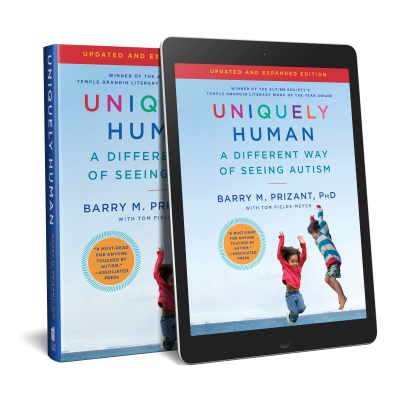
Uniquely Human, the book (Updated and Expanded edition!)
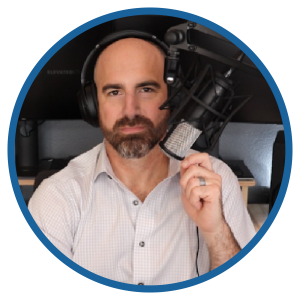
Dave Finch
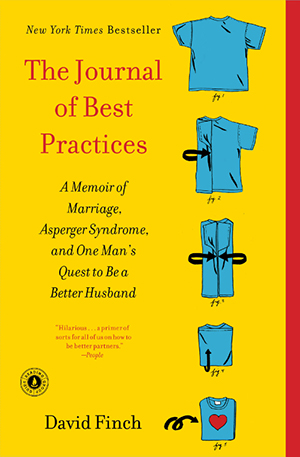
Dave Finch is the author of the New York Times bestselling memoir, The Journal of Best Practices: A Memoir of Marriage, Asperger Syndrome, and One Man’s Quest to Be a Better Husband. As a writer and creative consultant, his work has appeared on ABC, CBS, NBC, CNN, NPR, SiriusXM, The New York Times, Rolling Stone, The Howard Stern Show, and the award-winning Netflix series, Atypical. Based in Denver, Dave’s company, Elevated Studio, produces this podcast and other recognized series.
Visit Dave’s website here
“I have read a million and one books on Autism. Uniquely Human is the best book I have ever read, hands down. Thank you Barry for this incredible gift!!!!”
– Navah Paskovitz, Mother of three boys with Autism, Co-Founder, the Ed Asner Family Center
“Compassion, learning and supportive strategies–the three essentials for working with folks with ASD–are an integral part of this must-read book.”
– Michelle Garcia Winner, Speech Language Pathologist and Founder of Social Thinking
“Thanks be to Barry for the first-ever must read written for parents, educators, and clinicians.”
– Michael John Carley, Founder, GRASP; Author of Asperger’s From the Inside-Out
“What makes the book compelling is how funny Mr. Finch is about himself. He’s great company.”
– Susannah Meadows, The New York Times
“In this hilarious memoir (which also gives some of the finest explications of Asperger’s out there), Finch approaches trying to be a better husband and father with the determination of Sherman marching on Atlanta.”
– Judith Newman, People (4/4 stars)
“Talk about being on a roll. This dude wrote a book, he has Asperger’s syndrome. He cured himself by listening to me on the radio!”
– Howard Stern