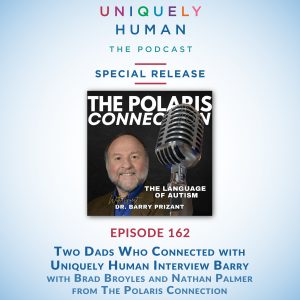
EPISODE 162
Two Dads Who Connected with Uniquely Human Interview Barry. With Brad Broyles and Nathan Palmer, from The Polaris Connection
Play the Episode…
Show Notes
This episode is a replay of The Polaris Connection, an autism parenting podcast hosted by Brad Broyles and Nathan Palmer. In this episode, they interview Barry with specific attention given to how Uniquely Human has had a positive impact in the way they see their children and support their development. Brad and Nathan are also the founders of Polaris Academy. The podcast offers advice, expert insights, and real-life stories to help families of neurodivergent children navigate special education, therapies, and daily life.
Featuring
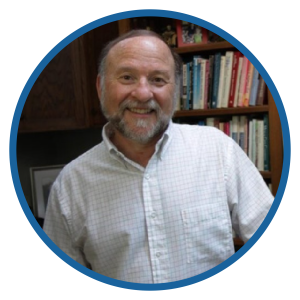
Barry Prizant, Ph.D., CCC-SLP
Dr. Barry Prizant is a speech-language pathologist with more than 50 years experience as a researcher and international consultant for autistic and neurodivergent individuals and their families. He is an Adjunct Professor of Communicative Disorders at the University of Rhode Island and Director, Childhood Communication Services (a private practice). Previously, he served as Associate Professor in the Department of Psychiatry in the Brown University School of Medicine, and held a tenured professor appointment at Emerson College. Publications include 5 books, most notably Uniquely Human: A Different Way of Seeing Autism (2015; 2022) and The SCERTS Model manuals, an educational approach implemented in more than a dozen countries. He has published 150 scholarly chapters and articles and serves on numerous professional advisory boards for journals and professional organizations. Barry has presented more than 1000 seminars and keynote addresses internationally, including two invited presentations at the United Nations for World Autism Awareness Day. His career contributions have been recognized with honors from Brown and Princeton Universities, the Autism Society of America and the American Speech-Language-Hearing Association.
Visit Barry’s website here
Uniquely Human, the book (Updated and Expanded edition!)
Dr. Barry Prizant is a speech-language pathologist with more than 50 years experience as a researcher and international consultant for autistic and neurodivergent individuals and their families. He is an Adjunct Professor of Communicative Disorders at the University of Rhode Island and Director, Childhood Communication Services (a private practice). Previously, he served as Associate Professor in the Department of Psychiatry in the Brown University School of Medicine, and held a tenured professor appointment at Emerson College. Publications include 5 books, most notably Uniquely Human: A Different Way of Seeing Autism (2015; 2022) and The SCERTS Model manuals, an educational approach implemented in more than a dozen countries. He has published 150 scholarly chapters and articles and serves on numerous professional advisory boards for journals and professional organizations. Barry has presented more than 1000 seminars and keynote addresses internationally, including two invited presentations at the United Nations for World Autism Awareness Day. His career contributions have been recognized with honors from Brown and Princeton Universities, the Autism Society of America and the American Speech-Language-Hearing Association.
Visit Barry’s website here
Uniquely Human, the book (Updated and Expanded edition!)

Brad Broyles
Brad has been married to Dustyn for over eighteen years and have six active children. They both have sponsored and volunteered their time to many children organizations such as Child Help, Operation Underground Railroad and Music and the Message.
Brad has over twenty years of business development experience, mostly in real estate acquisition, expansion and in the banking industry. Over the past five years, he has been a consultant with multiple companies in growing operations over the Southwestern Region of the United States. He specializes in business modeling, feasibility studies, contract negotiations, marketing, forecasting and business delivery.
Brad graduated with a Bachelor’s of Science in Business Management with a concentration in Accounting from the University of Phoenix and a Master of Real Estate Development from Arizona State University. In addition, he holds an Certificate in Commercial Lending and Forensic Accounting from the Center of Financial Training.
Brad has been married to Dustyn for over eighteen years and have six active children. They both have sponsored and volunteered their time to many children organizations such as Child Help, Operation Underground Railroad and Music and the Message.
Brad has over twenty years of business development experience, mostly in real estate acquisition, expansion and in the banking industry. Over the past five years, he has been a consultant with multiple companies in growing operations over the Southwestern Region of the United States. He specializes in business modeling, feasibility studies, contract negotiations, marketing, forecasting and business delivery.
Brad graduated with a Bachelor’s of Science in Business Management with a concentration in Accounting from the University of Phoenix and a Master of Real Estate Development from Arizona State University. In addition, he holds an Certificate in Commercial Lending and Forensic Accounting from the Center of Financial Training.
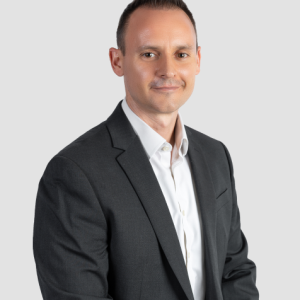
Nathan Palmer
Nathan and Darcy are Co-Founders of Polaris Academy, Nathan currently serves as its CEO. As parents of an autistic child, Nathan and Darcy experienced the frustrations of finding a school environment that would best suit the needs of their son. Combining their talents and resources, Nathan and Darcy were able to assemble a core team of educators, therapists, and strategic partners with the shared vision of creating an exceptional school for autistic and other children with unique needs by incorporating the latest in curriculum, design, and experiential instruction found at Polaris Academy.
Nathan and Darcy developed and jointly own a successful Real Estate brokerage and Law firm. Nathan has experience as an attorney, broker, consultant, and developer, and Darcy has a history in real estate sales, business/office management, and experience and training with autistic children.
Nathan and Darcy are Arizona natives and have been married for over 20 years with four beautiful children.
Nathan and Darcy are Co-Founders of Polaris Academy, Nathan currently serves as its CEO. As parents of an autistic child, Nathan and Darcy experienced the frustrations of finding a school environment that would best suit the needs of their son. Combining their talents and resources, Nathan and Darcy were able to assemble a core team of educators, therapists, and strategic partners with the shared vision of creating an exceptional school for autistic and other children with unique needs by incorporating the latest in curriculum, design, and experiential instruction found at Polaris Academy.
Nathan and Darcy developed and jointly own a successful Real Estate brokerage and Law firm. Nathan has experience as an attorney, broker, consultant, and developer, and Darcy has a history in real estate sales, business/office management, and experience and training with autistic children.
Nathan and Darcy are Arizona natives and have been married for over 20 years with four beautiful children.
Uniquely Human: The Podcast
EPISODE 162
A SPECIAL REPLAY EPISODE:
BARRY PRIZANT ON THE POLARIS CONNECTION
🎤 Transcript and Audio Usage Disclaimer
© Uniquely Human: The Podcast. All Rights Reserved.
The contents of this podcast, including all audio recordings, transcripts, and related materials, are the intellectual property of Uniquely Human: The Podcast and its fiscal sponsor, Community Autism Resources, a registered 501(c)(3) nonprofit organization.
These materials are provided solely for personal, educational, and non-commercial use.
No portion of the podcast audio, transcript, or any derivative materials may be reproduced, redistributed, modified, or publicly displayed without prior written consent from Uniquely Human: The Podcast or its authorized representatives.
Transcripts are provided for accessibility and reference purposes. They may contain minor transcription or formatting errors. When quoting or referencing the podcast, please credit Uniquely Human: The Podcast and provide a link to the original episode page.
By accessing or downloading transcripts, you agree to comply with this usage policy and acknowledge that all copyrights, trademarks, and intellectual property rights remain the exclusive property of Uniquely Human: The Podcast and its creators.
For permissions or inquiries, please contact:
📧 uniquelyhumanpodcast@gmail.com
Podcast Disclaimer Intro
Uniquely Human: The Podcast
[00:00:00] UHP: The primary purpose of Uniquely Human: The Podcast, is to educate and inform. The views expressed during all episodes are solely those of the individuals involved and do not constitute educational or medical advice. Listeners should consult with professionals familiar with each individual or family for specific guidance. , is produced by Elevated Studio. Music is graciously provided by Matt Savage of Savage Records.
Meet The Hosts
[00:00:39] Barry: Hi, I’m Dr. Barry Prizant, clinical scholar, researcher, and consultant on autism and neurodiversity, and a Brooklyn boy raised in the big city.
[00:00:49] Dave: And I’m Dave. I’m none of those things, and I grew up on a farm in Illinois. But being on the spectrum myself, I have plenty of personal insight to lend.
[00:00:59] Barry: And this is Uniquely Human: The Podcast, a show that illuminates and celebrates autism and neurodiversity.
Special Replay Episode
[00:01:15] Barry: So today on Uniquely Human: The Podcast, we’re having a special episode. And if I could be a little self-indulgent, I’ll share that the episode actually is a replay of a podcast interview that I was on, with a couple of dads from the Polaris School in Arizona. And I think what’s so special about it is having dads speak with me about their changing perceptions of their kids — in particular, how they needed to kind of look beyond the stereotypes and in some cases the negative attributions that are often thrown at the whole concept of autism and especially autistic people. So I thought it was a wonderful discussion, and therefore we’re gonna share it with you as today’s podcast. So enjoy.
Beyond Autistic Behaviors
[00:02:11] Barry: The whole notion is there’s no such thing as autistic behaviors, because once you just call them autistic behaviors — the term that’s used a lot now, that I’ve been using for years — you pathologize them. It’s something that’s wrong. It’s something that’s bad without asking what I call the deep why. Well, why is the child doing that?
Players Connection Welcome
[00:02:33] Brad: Hello everyone, and welcome to The Players Connection, your podcast that connects parents of autistic children with industry experts. I am your host, Brad Royles, and I’m here with my uniquely superhuman extraordinaire co-host, Nathan Palmer.
[00:02:49] Nathan: Brad, thank you. I can’t wait to be here. You know, that reference — “uniquely human” — I think is something we’re gonna play off of a lot today because we have with us today the author of a book called Uniquely Human, Dr. Barry Prizant. Doctor, so glad to have you here with us today.
[00:03:04] Barry: Thank you. Brad and Nathan, pleasure to be with you.
Why Barry Prizant Matters
[00:03:07] Nathan: Now, Brad, you said this is something where we connect families with industry experts, and I want to really qualify that here because in talking about experts, Dr. Prizant is a leading expert in the field. Dr. Prizant has 50 years of experience as a scholar, a researcher, an author, and an international consultant. Among other things, he’s had numerous awards from the Princeton University Eden Foundation for improving quality of life for persons on the autism spectrum, and honors from the American Speech-Language-Hearing Association. He’s also a certified speech pathologist, has been a two-time featured presenter at the United Nations World Autism Awareness Day, and has really been just a huge advocate for the cause. So Doctor, I can’t thank you enough for being here and for being willing to share some of your insights and unique perspectives with our listeners. And on top of it all, also the co-host of his own podcast, Uniquely Human — the podcast.
[00:04:11] Brad: Yeah. And please — please listen. Please subscribe to it. It’s full of wonderful information. So Doctor, thank you for being with us.
[00:04:18] Barry: Great. Thank you.
Uniquely Human Book Setup
[00:04:20] Nathan: Now, to kick us off, I really want to dive into that uniquely human concept. There are so many wonderful things from that book. I’ve read it — I cannot recommend it enough to our listeners. I think we’re gonna put a link on our site. And you’ll see why as we dive into it. It is just an approach, frankly Doctor, that I wished I had been fully aware of when I first found out my son was on the autism spectrum.
[00:04:48] Barry: Mm-hmm.
[00:04:48] Nathan: You intentionally dive into things that I think I’ve only stumbled across as I’ve come to understand more and more my own child, and I have a feeling you’re gonna help to upgrade and just accelerate people’s perceptions and perspectives on the potential of their own kids and others in the community.
Summer Camp Origin Story
[00:05:11] Nathan: But to back way up — I was inspired by the story in the book of how you were first introduced to the world of autism, something about a summer camp and a girlfriend, and I wondered if you could tell us that story in a brief moment.
[00:05:27] Barry: Sure. I was in my late teen years working a drudgery job in New York City. I grew up in Brooklyn, so I’m a city kid. And my girlfriend, after the first year of college, was upstate New York and was working at a summer camp for not just children, but adults with disabilities. We missed each other, and she contacted me and said, “Oh, a counselor just left. There’s an opening. Why don’t you apply?” And I went up there, and I believe it was right around 1969. I always like to say later that summer I went to Woodstock. But we’re talking about way back when, and I was just immersed in a world that I had never experienced really, where I was living 24/7, responsible for the care and wellbeing and happiness of a wide variety of individuals with different disabilities — and some of them had a label of autism, some of them were definitely autistic but did not have that diagnostic label. And I just fell in love with the work.
[00:06:37] Brad: Wow. And back then, since autism wasn’t really well known at that time, what drew you to that audience, or what drew you to those individuals where you’re like, “I really like this”?
[00:06:52] Barry: Yeah.
Language Path To Autism
[00:06:53] Barry: Well, quickly — I was just starting college, and I was a failed German major. I knew I wasn’t gonna be able to proceed after the first year, and I went into linguistics in a field called psycholinguistics, which is the study of the relationship between thought and language and communication. And of course, there I am that summer surrounded by people who have problems moving from what they’re thinking to communicating that information. So I almost had a parallel track, because I continued for five more summers at summer camps — academically I was studying everything from thought and language and communication disorders, and then working with people during the summers — and then went on for advanced degrees in speech-language pathology.
[00:07:45] Brad: Wow. That’s pretty neat. So you took the background of language to understand the neurodiversity language of behavior. That’s incredible.
[00:07:56] Nathan: Yeah. And I think that was a theme that was most inspiring from your book. I think your training and your approach in communication and language almost painted autism, Doctor, as its own form of a language. And discovering and decoding that language is more important than trying to modify the behaviors associated with that language. Did I say that in a justifiable way?
[00:08:27] Barry: Oh yeah. You were very clear and spot on with that.
Echolalia As Communication
[00:08:31] Barry: And that’s what actually led to my doctoral dissertation — my PhD in communication disorders. I was working with kids who repeated speech a lot, which, as you know, is known as echolalia. But the literature at that time was saying it was psychotic speech, it was meaningless parroting, and it needed to be discouraged, if not extinguished. And I was working with young kids who were doing a lot of different things with their echolalia, and then I went to the parents, who I knew really well. These were all kids four and five years of age. And I went to the parents and said, “You know, David repeats a lot of what you say. If you say, ’Wanna go out?’ he’ll say, ’Wanna go out?’” Or “He’ll say things that he’s heard from you and your husband or from videos.” And the parents told me what they thought it meant. And what they said contrasted greatly with the technical literature — they saw it often as meaningful and an attempt to communicate. Not in all cases, but in many cases. So that’s what earned me my PhD. And a lot of it did come from parent perceptions, which to this day I value right up there with any technical research in the literature.
[00:09:52] Brad: Yeah.
Parents As True Experts
[00:09:52] Brad: And I love how you said that. It sounds so simple, but parents — you know your child, and you can listen to them, and you know what they’re trying to communicate with you. Is that kind of the idea?
[00:10:03] Barry: Exactly, yeah. And you know, what I always like to say is — years ago I used to say, “Well, parents may not be an expert in autism, but they’re an expert on their kids.” And now so many parents have become experts in autism. They’re kind of forced into it.
[00:10:18] Nathan: Experts on their kids. Yeah.
From Fixing To Supporting
[00:10:19] Nathan: Well, and it’s such a refreshing view because, you know, in the early days of being an autism dad — the intent, and this is a male approach, we like to fix things — my initial reaction was, “All right, how do we fix this? How do we make this more normal? How do we help him conform to what our expectations are? How do we fit him into our mold?” And so the intent initially of seeking out all these therapy supports was a fixed mentality.
[00:10:51] Barry: Yes.
[00:10:51] Nathan: And over time, that has shifted to a support mentality. And the wonderful thing about your book is you dive into let’s not make this an approach of how do I get rid of these autistic behaviors. You instead shift it to what do the behaviors mean? What are they communicating? What do they say about the child and their needs, and how can we communicate back and understand? And there was a section where you posited this theory that the behaviors of an autistic person are really no different than the behaviors of any person. In fact, anything they do, we also do in some form — and there’s commonality in the reasons. Could you talk about that just for a moment?
No Autistic Behaviors
[00:11:36] Barry: Yeah, and that’s actually something I learned from an autistic woman who I speak about quite a bit in the book, Roz Blackburn.
[00:11:44] Nathan: Yeah.
[00:11:44] Barry: The whole notion is there’s no such thing as autistic behaviors, because once you just call them autistic behaviors — the term I’ve been using for years — you pathologize them. It’s something that’s wrong. It’s something that’s bad without asking what I call the deep why. Well, why is the child doing that? So what I learned from Roz is these are all human behaviors. These are human beings as much as any person is a human being behaving. And Roz gives wonderful examples, like, “You look at me when I get excited and I’m rocking and flapping. Well, look at what happens in an NFL football game when your team scores a touchdown.” Everybody’s jumping up and down and rocking and flapping. And then she went on to say, “I just get excited more easily than you do.”
Stimming And Regulation
[00:12:46] Barry: And one of the big things that we learned is a lot of what was called self-stims, or self-stimulatory behavior — the attempt to increase sensory input or motor output — for years was thought of as an autistic behavior, and the way to treat autism was to get rid of those behaviors. In our early work, which became part of our educational model, the SCERTS model, we said, “Wait a second. It seems that in many cases, when kids do what’s called self-stims — whether it’s staring at their fingers or rocking or flapping or spinning — it’s an attempt to stay better regulated emotionally or physiologically. It’s to calm themselves. It’s to help make themselves more alert.” And then if you take it to the next step, we often do a lot of those things, but we tend to hide them better. We don’t do them in public when people are watching us. Or we learn other ways that are more socially acceptable. So yeah, we all self-stim — and that’s part of the notion of uniquely human.
[00:14:05] Brad: So again, we all have those similar behaviors. Some people do different types of masking than others. Others demonstrate it more publicly. So let me make sure I say this right — you’re saying there’s no autistic behaviors, just human behaviors?
[00:14:28] Nathan: There’s no autistic behaviors. There’s just human behaviors.
[00:14:31] Brad: Human behaviors. That’s how you say it.
[00:14:33] Nathan: Yeah.
[00:14:35] Nathan: And my mind exploded when I was reading that, because it was this moment where I felt really connected to things that my son used to do that used to frustrate me, frankly. My son has a tendency sometimes to pick at his fingers — I know that’s a common one. Well, sometimes I bite my nails.
[00:14:56] Dave: Mm-hmm.
[00:14:57] Nathan: Exactly. And it’s the same thing. Or you see people sometimes when they’re a little distressed — they might rub their arms or crack their knuckles or roll their neck out. There are all these physical things we do. Or if I’m presenting, some presenters get nervous and might rock back and forth a little bit. And I’m rethinking all these totally normal behaviors I’ve seen, experienced, and done — they’re for the same reason that maybe an autistic person is doing them. So I love the point: the behavior is not the focal point. The question is, why are they doing that behavior? And in that we find this commonality — oh, they’re regulating just like me, but it looks different.
[00:15:41] Brad: Yeah.
Finding The Deep Why
[00:15:41] Brad: And can you explain a little bit more about the deep why? How does that process work?
[00:15:48] Barry: Yeah. The deep why — in part, we can get to it sometimes if we have the humility to reflect on ourselves and say, “Well, wait a second, I do something that maybe is a little different, but it’s the same purpose of decreasing anxiety or letting a lot of energy out that I have.” We have a new puppy who’s now a year and a half old, and as puppies do, they go through the zoomies certain times of day. They’re running around like little crazed creatures, and that has to do with dealing with their arousal level. They got revved up. They need to get that energy out. And sometimes people might look at a child on the autism spectrum who’s spinning and jumping up and down or climbing — and in a sense, they’re doing the zoomies. Typically developing young kids go through the zoomies at certain points in time as well.
[00:17:00] Barry: So I think the deep why is really trying to understand — and I’m not saying it’s always easy to do — what is this child or this person experiencing from their perspective? What are they experiencing physically? Do they have too much energy that they need to get out? Are they so fearful that they’re dropping to the floor before they step into a noisy cafeteria? What is their experience? And in some cases, we’re taking educated guesses. But if we’re good observers, then we see the patterns over time. “Oh, well, my daughter drops to the floor whenever there’s an unexpected noise,” or she’s had the experience of going into a setting that was overwhelming for her.
[00:17:45] Barry: So what is that? Is that an autistic behavior or is that a protest? The protest being, “I don’t have yet a way to say no thank you, so I’m gonna protect myself. I’m gonna try to survive.” And I think a lot of what I’ve learned from autistic adults that I know and work and collaborate with is the survival instinct behind some behavioral patterns — especially behaviors that are considered to be more challenging or difficult. Maybe that person is pushing you away because you’ve stressed that person out before, and they have a memory of you being a trigger for that. Or the opposite — maybe that little guy is always seeking out one special ed teacher in a classroom because of wonderful positive memories. My point is, we need to go past the behavior, beyond just labeling it, and look at the patterns that give us insight into the child’s experience.
[00:18:48] Nathan: Yeah, I almost want to replace the word “behavior” with “language.” There’s no autistic behaviors, but there is autistic language. And one is something I want to get rid of — the other is something I want to understand. It’s almost a shift in focus, because instead of just focusing on the behavior — and I’m of the belief that the more we focus on something, the larger it gets — we become closed off to everything else. We tend to hyper-fixate on the behavior because, half the time, it’s not a problem for the child. They’re doing something that for them is normal. It’s only a problem for us, so it’s our perception that’s causing the issue.
[00:19:30] Nathan: But if we can take our focus off of that and instead — if it’s language — understand what’s driving it and look at the environment and broaden our scope, now we can pick up those contextual cues that help us to be detectives in trying to decode language and understand. And the more proficient we become in that dialogue, the more our understanding grows, the more our empathy grows. And I think the more we can adapt ourselves to their world, not the other way around.
[00:20:02] Barry: Yeah.
Culture Shapes Perception
[00:20:02] Barry: Yeah, I just want to add quickly — some of our perceptions are culturally conditioned. And I’ve had the great benefit of consulting in other countries, non-Western countries. We’ve interviewed First Nations people from Canada, and Native American families and parents on our podcast. And so if a child is in a supermarket and mom or dad’s with the child and the child drops to the floor just before the checkout lane, our cultural conditioning might say, “Oh, there’s a spoiled brat,” or that mom or dad doesn’t know how to discipline their child.
[00:20:40] Brad: Mm-hmm.
[00:20:40] Barry: In other cultures, the first thing they may go to is, “Why is this child so distressed? How can I comfort this child?” And as you know, sometimes we’ve been taught that if you pay attention to a child who is dysregulated, who’s having behavioral difficulty, you shouldn’t pay attention — you’re reinforcing that behavior. So much of that is culturally determined, and I like to look at other cultures who may look through a totally different lens when they look at young kids.
[00:21:10] Brad: Is there a culture that really jumps out to the top of your mind that kind of helps a little bit more with that perspective?
[00:21:17] Barry: Oh, yeah.
Cree Perspective Gifts
[00:21:18] Barry: A Native American father that we interviewed — a dad named Grant Bruno, who happens to be a researcher up in Canada. And he made a short video, which is now gonna be made into a full-length film, called The Gift of Being Different. He’s a Cree Native. And what Grant says is — he did say at first he was distressed when the diagnosis came — but then he went back to his culture, and his culture taught him that our children choose us as parents, and we need to be responsible as parents. And he sees as many gifts in his sons — he has two autistic sons — he sees as many gifts as… He’s not sugarcoating challenges, but he sees his kids as gifted. And he actually believes, and his culture believes, that when we are all born, the rest of us leave the spirit world and we enter the reality on the ground world here. And his culture believes that autistic and neurodivergent kids only partially leave the spirit world — they’re living partially in the spirit world and in the reality world. And sometimes it’s not a good match.
Empathy Shift For Parents
[00:22:41] Nathan: I’m appreciating the power of just a simple shift in perspective. The cultural experience of autism globally versus just what we know in our culture. And you’re right — shifting something as simple as that — one foot in and one foot out of the spirit world — adds a level of empathy and of curiosity
[00:23:12] Barry: Yes…
[00:23:12] Nathan: right, that replaces the frustration. And I think half the frustration a parent has in an autism world is we feel embarrassed as the parent.
[00:23:26] Barry: Mm-hmm. Yes.
[00:23:27] Nathan: And that is not a shared experience with the child, and we’re, a lot of times, creating our own drama. And I think the biggest thing I enjoyed about your book, Uniquely Human, was it made me feel a little more empathy towards myself — that it’s okay, I’m just human. And I found myself, in each chapter, connecting more and more on these memories and these experiences that I’ve had with my son that released the frustration and made me eager to want to dive into that language and figure out what is he really saying. I understand him a lot, but I’m excited now to discover more — and that’s not something I could say I wake up with every day. And I know so many other kids on the spectrum that I’m just anxious to go in and discover their world with them.
[00:24:15] Brad: Mm-hmm. And Doctor, I love how you said that in their culture, the child chooses the parent.
[00:24:24] Nathan: Yes.
[00:24:25] Brad: And I love that. It’s a different perspective because we have some parents out there who are like, “Well, why did this happen to me?” Rather than, “Wow, this is a gift — that child chose me.”
Gratitude Stories
[00:24:36] Brad: So for all those that are listening out there, please drop us a line — share what you are grateful for of what your child has given you now that you’re raising an autistic child. We would love to hear some comments on that.
[00:24:50] Nathan: Or even language discoveries. I think the more we share moments like “my child did this, and for the first time I realized it means X instead of Y” — the more we all grow.
[00:24:58] Barry: Yes. Yeah. And I could share some additional stories you could look towards, especially on our podcast. Shameless plug, but not really — they’re wonderful stories.
[00:25:07] Brad: No, plug away.
Miracle Project Mom
[00:25:08] Barry: Elaine Hall — who’s a very dear friend, and she’s a mom. She adopted a young boy at two years of age from Siberia, who ended up being, quote-unquote, “severely autistic.” She developed the Miracle Project Theatre expressive arts program in LA, which has been going on for close to 20 years, and we did a whole podcast with her. She’s one of the most spiritual people I know — not in a religious sense, but in a deeply kind sense of gratitude for life. And we did a whole discussion with her about gratitude. Now her son is close to 30 years of age. He’s non-speaking, but he also has a wonderful quality of life. Lives in his own apartment with support. And it’s just amazing when you hear these stories of gratitude from parents.
[00:26:10] Barry: And we interview a lot of autistic and neurodivergent parents themselves, who discovered their own autism as adults because their child was diagnosed, and they thank their child for that discovery. Because it clears up so many questions about the life and the struggles that they’ve had. So I think gratitude is a huge piece.
[00:26:35] Barry: In the early years, it might be really tough when a family has to totally change their life routines — they’d be more financially stressed for the extra money they need to put out for services or for whatever else. But I have found in the long term that so many parents come back and say, “Hey, would we change our lives? Would we wish that our child was not autistic?” And they say — and I’m gonna surprise a lot of people — “I’m not so sure about that.” Because they think about where their lives are now, especially when they talk about the wonderful communities and the wonderful people they’ve met in their lives.
[00:27:13] Nathan: Yeah.
Community Changed Us
[00:27:13] Nathan: We echo that here. I always joke I was thrown into the world of autism — it wasn’t by choice, it came to me.
[00:27:22] Brad: And then Nathan threw me into the world of autism.
[00:27:24] Nathan: I dragged everybody else into it with me. Meeting professionals like yourself that charged in headfirst — that community is one of the best I’ve ever been exposed to.
Behavior As Language
[00:27:36] Nathan: And it’s funny — I’m sitting here processing and I’m almost looking at the danger of trying to program out behaviors from our autistic kids. Because if we’re really looking at it as language, as coping strategies, as things that we all do, I think the unintended consequence of hyper-focusing on the, quote-unquote, “behavior” is we’re now taking away language. We’re taking away coping strategy. And if we did that to any human and took away whatever calming mechanism you had, took away your ability to be expressive —
[00:28:11] Brad: Mm-hmm…
[00:28:11] Nathan: we might actually cause more harm than good. And so then the workaround is instead of us trying to change the autistic child, it’s how can we change ourselves and make our world more inviting and adaptable to them? And that’s an approach I think that just makes us all better. I can say hands down, I’m a much better and more effective father today because I’ve had to have some of these intentional deviations from what I thought parenting was, and I owe that to my son on the spectrum. Without that, I think I might have been a little more aloof or maybe not quite as engaged or not quite as intentional with some of the things I did to connect and teach my children. Would I go back and change it? No, absolutely not.
[00:28:55] Barry: And many parents — and I say this from direct experience — I’ve mentioned that we do a parent retreat weekend. We’ve been doing it for 28 years. Over those years, we’ve probably had 400 to 500 parents come — we have 60 parents every year. And they say, “I’m a more compassionate human being.” We get parents of newly diagnosed kids, and we get parents of — believe it or not — autistic adults in their 30s and now approaching 40 years of age. And the mentoring and the generosity that the parents show to each other in that weekend is just amazing. But they often talk about what they’ve learned about being a better human being by having a family member who’s neurodivergent or on the autism spectrum.
Parent Retreat Weekend
[00:29:49] Brad: Well, let’s speak about this retreat. You do it once a year — tell us a little bit more about the next retreat. Where is it? How do I get more information? How do we share this with our families?
[00:30:00] Barry: The next retreat actually is in a few weeks — the first weekend in May. It’s probably full by now. We do it with an agency, a nonprofit called Community Autism Resources, which is a state-funded regional resource family center in Massachusetts. And the site — we had one beautiful setting out in the middle of the country around a lake, but unfortunately that shut down. And now we have a new setting that’s actually owned by Boston College. It’s called the Connors Center, and it’s about 45 minutes from Boston and Providence — and I’m based in Providence. And it’s just an amazing immersion experience for parents where they don’t feel they have to be judged, where they feel like, you know, I could tell a story about what my child did, and in any other setting, they would look at me cockeyed like, “What?” And in this setting, everybody just nods knowingly and says, “Yeah, we get it.”
[00:31:15] Barry: And the comment that so many parents say, especially the newcomers, is, “We don’t have to explain ourselves here.” We’re immersed in a setting of compassion and understanding, and so often — as you guys know — the challenges might be the judgmental attitudes that happen in public, or even in schools that are well-intended but don’t realize they’re being terribly judgmental.
[00:31:45] Barry: So it’s just a wonderful experience. Hands down, one of my greatest learning experiences. And in the book Uniquely Human, we have a whole chapter on the parent retreat weekend. And what some parents say is absolutely mind-blowing. One dad — who I believe is a Hindu gentleman — said he wakes up every morning and looks in the eyes and the face of his child and sees the face of God. And not even to mention the very often beneficial effects on siblings. So many brothers and sisters go into professions of helping other people —
[00:32:20] Nathan: Yeah…
[00:32:20] Barry: having had that experience. I’m not saying it’s not challenging sometimes growing up and having a neurodivergent brother or sister, but what I am saying is in the long run, the learning that goes on is amazing.
[00:32:32] Brad: You know, Nathan, can’t you just feel the doctor’s passion and love for his work? Like, I wish everybody could see you, Doctor. There’s such a glow about you as you’re talking about your work, your research, and the great benefit that you’re giving our wonderful community. And I love how you said that even on these retreats that you learn a whole lot. It sounds like you might learn more than what parents might learn at these retreats. Is that correct?
[00:33:01] Barry: Oh, absolutely.
Immersion Beats Stigma
[00:33:02] Barry: And not just the retreat — in my collaborations with autistic people. I have some good buddies who are autistic, and they’re not people I treat. These are people I hang out with. And people often ask me, “What advice would you give to young professionals?” And I would say, “Immerse yourself in the world where neurodivergent and autistic people live twenty-four/seven — with the families, with the people themselves.” Because the way you get past stigma — having to do with stereotypical views of what people are and their label — “Oh, that’s an ADHD person,” or “That’s a person with a mental health issue,” or “That’s an autistic person” — the way you get past the stigma is with close contact, when you have everyday experiences with that child or have everyday experiences with that adult and say, “Wait a second.” This shatters so many of the stereotypes that are out there.
[00:34:05] Nathan: Yeah.
[00:34:05] Barry: And that’s what I’ve benefited from, yeah.
[00:34:08] Nathan: Yeah, and it has the effect… Brad, I’m glad you pointed that out because so much of what we communicate is unspoken. Just as much as we’re talking about decoding the language of our peers or our kids or other social community members that are on the spectrum, we are also communicating using expression and tone and body language as language. And I almost have to rewind and ask myself the question, what was I actually communicating to my child?
[00:34:43] Barry: Yes.
[00:34:43] Nathan: When I get reactive, when I get overexpressive, when I get frustrated — even if I’m trying to be nice and kind — the truth is that you feel and you read that intention. Even if I say, “Oh, that’s okay,” and I’m trying to be empathetic, but I’m really deep down frustrated, they will feel, hear, and experience frustration.
[00:35:05] Nathan: And so a lot of the back-end of this dynamic change — of just looking at people as other humans, looking at behavior as language — is our own language shift and our own behavior shift, and that’s palpable. That comes off in how we treat and deal with other people, and I think that just upgrades society as a whole.
[00:35:24] Barry: Yeah.
Connection And Trust
[00:35:25] Barry: And if I could highlight two words. As I look at your screen, I see a little caption at the bottom that says, “The Polaris Connection.” So one word is connection. Connecting with another human being who happens to have a pattern of behavior that falls under this category that we made up called autism. So connection is number one, and something I talk about in great detail in Uniquely Human is the notion of trust. That we seek out people who we trust. We seek out settings and activities where we feel, in a sense, we could trust being in this sensory environment. We could trust being in this school because what they’re teaching me makes sense to me. I could trust my body because I can deal with things that are too loud — or whatever it might be on a sensory level. But the important piece here is the human piece of connecting and developing trust, and that’s what you’re talking about.
[00:36:33] UHP: Yeah.
[00:36:33] Barry: Because once you have that connection, then the people you are with are willing to take risks, are willing to learn with you and from you, are willing to feel trustworthy enough that they could say, “I don’t wanna do that,” and know you’ll respect that.
[00:36:52] Nathan: Yeah.
[00:36:54] Nathan: I love that.
Boundaries And Safety
[00:36:54] Nathan: Well, trust drives safety. I remember this, and I’ll take it with me forever — there was somebody talking about trust and boundaries, and they used the example of a rollercoaster. I love rollercoasters. I’m a little bit of a junkie.
[00:37:12] Brad: You’re a thrill seeker.
[00:37:14] Nathan: I can be.
[00:37:14] Brad: One of your zoomies, right?
[00:37:16] Nathan: It is. I’m an introvert, but that’s where I get my positive energy from — other experiences. And you know, when you sit in a rollercoaster, the very first thing you do almost instinctively is push against the safety bar — not because you’re trying to get it to release, but because you want to make sure it’s there. You’re just doing a soft check. And having that trust sometimes — we do this too. It’s not just our autistic children. Any human does it. We test the boundaries around us, and it can sometimes seem like defiance, or it can sometimes appear as testing you — and they’re not. It’s the reassurance of, “Are you still there? Does this boundary still exist? Do you still have me? Can I rely on that safety net, on you being regulated, on you being that person there for me?” And it’s shifted how I look at boundary testing. I used to get frustrated like, “Why are you pushing? Why are you going there?” And really it’s looking for, as much as anything, reassurance. Maybe not always the case, but to your point, Doctor, it’s trying to decode the intent behind the behavior, not focus on the behavior itself.
Beyond Smiley Faces
[00:38:26] Nathan: I want to borrow something you taught in your book that I see everywhere in the autism community — further on this idea of language. You had a section about the little emotion faces. And I think almost everywhere I’ve gone, it’s the “This is happy, this is sad, this is frustrated.” And you kind of take issue, going “That’s the wrong way to teach emotion.” Could you talk a little bit about that?
[00:38:52] Barry: Yeah. That’s actually something I learned from Roz Blackburn, who I mentioned earlier. She said — and now Roz is in her 50s — this goes back probably 15 or 20 years ago when I had her over here, and I’m still in touch with her. And she said, “I never learned anything from those smiley and frowny faces.” She said, “People don’t look like that.” She said, “I never made that connection, yet I was drilled on it over and over again, and I always had problems getting it right.”
[00:39:30] Barry: And then the next logical question is, “Well, how did you learn about emotion words and emotional concepts?” She said, “When people use those words when I was feeling those feelings, and sometimes having a visual to go along with that. But I needed to experience those feelings and then hear the label or see the icon” — as opposed to pointing to happy, pointing to sad, when it had nothing to do with her experience at that time.
[00:40:05] Barry: And one thing I’ll add — this was discussed on one of our podcasts. One of my new colleagues, who’s an autistic researcher and a developmental psychologist, name is Jacqueline Fady. She says emotion words have never been meaningful for her. And she’s a very intelligent adult. She says, “I relate to energy levels. That I can talk about how the energy feels in my body.” And she and another one of my colleagues, Dr. Amy Laurent, put out a book called Energy. The whole idea of the Energy book is a manual to help autistic individuals relate to emotion through reading their energy levels in their body. Now Jacqueline is very clear — she’s saying, “I’m not saying this is the case for all autistic people. I’m just saying for me, I could never relate to emotion words. But I could relate to low energy and high energy and this kind of energy.” And I found that to be fascinating.
[00:40:59] Brad: Wow. Well, that makes sending emojis a little bit different now.
[00:41:02] Nathan: It does. And again, it speaks to this idea of language — because for us, the words have meaning. For others on the spectrum, or other neurodivergent conditions, it may not. But there are ways to still communicate it.
[00:41:16] Dave: Mm-hmm.
[00:41:16] Nathan: And that’s this theme I keep drawing on — it’s discovering a new way of communication, a new way of understanding, and in that world we find connection, we find meaning, and we find purpose. It’s just having a new kind of conversation.
[00:41:32] Brad: Yeah. And it is — and you kind of hear that a lot, that “sometimes I connect with you intellectually, but then I also connect with you emotionally” — which is energy. You know? I connect with the energy of that individual.
New Neurodiversity Book
[00:41:45] Brad: Doctor, I also heard that you’re writing another book.
[00:41:50] Barry: Yes.
[00:41:51] Brad: And you’re kind of in the final stages of your new book on neurodiversity.
[00:41:55] Barry: Yes.
[00:41:56] Brad: Can you tell us a little bit more about it? We’re all biting our fingernails about it.
[00:42:05] Barry: Don’t be anxious — that’s our role as writers. It’s another book, and again, my co-author, who is a father of an adult son with autism — Tom Fields-Meyer, based in Los Angeles — we were lucky enough to get a really wonderful contract from Penguin Random House, a very large publisher.
[00:42:20] Barry: And it goes well beyond autism. The book talks about neurodivergent conditions in general — it’s on neurodiversity — but how so many books on neurodiversity, you turn the first pages and there’s a section on ADHD, a section on anxiety disorders, a section on autism. We’re not going that way. We’re going the way of, again following from Uniquely Human, not only what is the experience of neurodivergent people, but also — and this is very important — how do we as relatively non-neurodivergent people ask the deep why. Understand the energy level of a person with ADHD who looks like they just can’t control that energy and they’re jumping from one thing to the next. But how can we support them better? And we also talk more about mental health issues, because probably one of the greatest understandings of both the research and real-life experience of neurodivergent people over the last 10 to 15 years has been the mental health impact of being misunderstood.
[00:43:35] Brad: Mm.
[00:43:36] Barry: Of people who don’t really try to ask the deep why and who dismiss you because they’re judging you only about your behavior at that level. And we’ve done now more than 150 podcast interviews, two-thirds of which are with neurodivergent individuals — not just autistic individuals. And we are drawing heavily from those interviews as well as from my personal experiences.
[00:44:15] Barry: So the book will have many, many more profiles of neurodivergent people, a lot of new profiles. Let me entice you a bit. I’ve developed a distant relationship with a Brazilian autistic policeman who read the Portuguese version. Uniquely Human has been translated into 27 languages now. And he read the Portuguese version and it was like, “Oh my God.” Self-diagnosed, then got clinically diagnosed. His name is Saulo Barbosa, and he’s wonderful. And we interviewed him on the podcast with a translator, and we tell his story. And what he’s doing now is he’s training police departments all over the country — and I got an email from him two weeks ago — now he’s also training people in the military in Brazil about how to understand and react to neurodivergent people. His story’s amazing. He’s a wonderful human being.
[00:45:10] Barry: We also interviewed a person called the Lavender Librarian from Toronto — who was late diagnosed, who was passionate about everything lavender. If you go to her website, it’s all lavender.
[00:45:21] Brad: That is awesome.
[00:45:22] Barry: And she’s an expert librarian who is respected internationally in the librarian community because of how she teaches kids and uses books to connect with children, whether neurodivergent or not. So those are just two examples of many, many profiles of really fascinating people.
[00:45:45] Nathan: I love it, and I love the common theme — at the end of the day, we’re all human. And you’re not focusing on the diagnosis, the pathology, as you say it. Instead, you’re taking a step back and relating their experience to our experience in a way that makes us understand we are a lot more alike than we tend to at first acknowledge and realize. And that’s — I think that was my favorite thing about Uniquely Human, and I imagine you’re gonna take the same approach in this new book about neurodiversity.
[00:46:14] Barry: We are.
[00:46:15] Nathan: All of those personal examples, all those anecdotal stories were like a roadmap. Because it gave me another way of seeing a behavior that now had meaning and purpose — maybe that’s not the language of my child, but it starts me on a path of looking for the language and understanding that there are other reasons and causes at play. It’s not just about stamping that behavior out. It’s about learning a new form of being human that is as beautiful and as rich and as fulfilling as any other out there. So thank you for that perspective and for really the start of what I hope is gonna be a new and beautiful journey for me and my family.
[00:46:57] Barry: Great. Well, thank you so much.
Purpose And Farewell
[00:46:59] Barry: Let me just add one quick comment. The other thing that I’ve really discovered in my senior years is watching people finding purpose and living a life of purpose. So many of the neurodivergent and autistic people I know that we really put a spotlight on have not only gone through their own trials and tribulations of being understood, but now they’re living a life of purpose, of giving back to the community — and that’s wonderful.
[00:47:26] Brad: Wow. Doctor, I’m a better person for having listened to you today. Thank you so much for your time. I write a lot when we have guests, and I almost have two pages of notes just from you, Doctor, so thank you so much for your time. And we’d sure love to have you back on the show.
[00:47:50] Barry: Great. Well, thank you for this opportunity. It’s been wonderful.
[00:47:53] Brad: Wonderful. Well, thank you folks for making us part of your day. Please don’t forget to subscribe so you never miss a conversation that inspires connection and trust. I’m gonna start using that more — I love that, Doctor. Thank you. Want to say thank you to our wonderful producer, Jesse Palmer, Dallin Davis, our wonderful director. Until next time, let’s do some good.
…and Continue the Discussion
Do you have a book or podcast club? If so, you may use this discussion guide to facilitate a conversation about this episode.
1) What was most striking to you about the shift of perspective experienced by Brad and Nathan after reading and being exposed to the Uniquely Human philosophy?
2) Which specific aspects in their children’s behavior do they now look at through a very different lens? Is this information new to you, or consistent with the perspective you have had for your child, your students, or others you know who are neurodivergent?
3) Brad and Nathan speak of the need to become a good observer of their children, and to always remain curious rather than close minded. Why is this important, especially given that it is not always easy to determine the “Deep Why” of a child’s behavioral patterns?
HOSTED BY
Barry Prizant, Ph.D., CCC-SLP
Dr. Barry Prizant is a speech-language pathologist with more than 50 years experience as a researcher and international consultant for autistic and neurodivergent individuals and their families. He is an Adjunct Professor of Communicative Disorders at the University of Rhode Island and Director, Childhood Communication Services (a private practice). Previously, he served as Associate Professor in the Department of Psychiatry in the Brown University School of Medicine, and held a tenured professor appointment at Emerson College. Publications include 5 books, most notably Uniquely Human: A Different Way of Seeing Autism (2015; 2022) and The SCERTS Model manuals, an educational approach implemented in more than a dozen countries. He has published 150 scholarly chapters and articles and serves on numerous professional advisory boards for journals and professional organizations. Barry has presented more than 1000 seminars and keynote addresses internationally, including two invited presentations at the United Nations for World Autism Awareness Day. His career contributions have been recognized with honors from Brown and Princeton Universities, the Autism Society of America and the American Speech-Language-Hearing Association.
Visit Barry’s website here
Uniquely Human, the book (Updated and Expanded edition!)
Dave Finch
Dave Finch is the author of the New York Times bestselling memoir, The Journal of Best Practices: A Memoir of Marriage, Asperger Syndrome, and One Man’s Quest to Be a Better Husband. As a writer and creative consultant, his work has appeared on ABC, CBS, NBC, CNN, NPR, SiriusXM, The New York Times, Rolling Stone, The Howard Stern Show, and the award-winning Netflix series, Atypical. Based in Denver, Dave’s company, Elevated Studio, produces this podcast and other recognized series.
Visit Dave’s website here
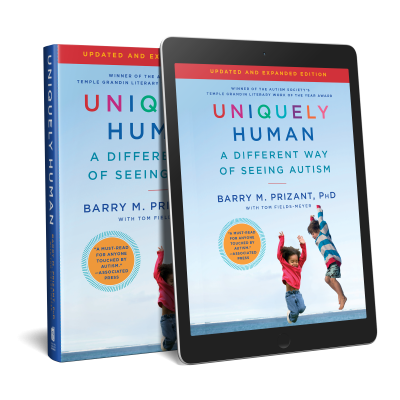
“I have read a million and one books on Autism. Uniquely Human is the best book I have ever read, hands down. Thank you Barry for this incredible gift!!!!”
– Navah Paskovitz, Mother of three boys with Autism, Co-Founder, the Ed Asner Family Center
“Compassion, learning and supportive strategies–the three essentials for working with folks with ASD–are an integral part of this must-read book.”
– Michelle Garcia Winner, Speech Language Pathologist and Founder of Social Thinking
“Thanks be to Barry for the first-ever must read written for parents, educators, and clinicians.”
– Michael John Carley, Founder, GRASP; Author of Asperger’s From the Inside-Out
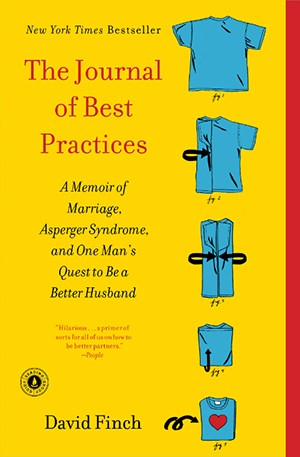
“What makes the book compelling is how funny Mr. Finch is about himself. He’s great company.”
– Susannah Meadows, The New York Times
“In this hilarious memoir (which also gives some of the finest explications of Asperger’s out there), Finch approaches trying to be a better husband and father with the determination of Sherman marching on Atlanta.”
– Judith Newman, People (4/4 stars)
“Talk about being on a roll. This dude wrote a book, he has Asperger’s syndrome. He cured himself by listening to me on the radio!”
– Howard Stern