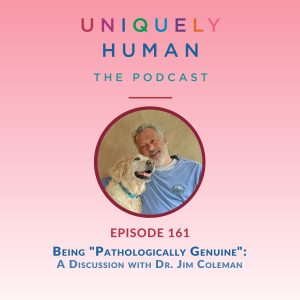
EPISODE 161
Being “Pathologically Genuine”: A discussion with Dr. Jim Coleman
Play the Episode…
Show Notes
Jim Coleman, a semi-retired biology professor has had an amazing journey. He discusses his late diagnosis as an autistic person and his journey from feeling like “a banana slug transported into the Mojave Desert” to embracing his neurodiversity. He shared his teaching philosophy of helping every student reach their full potential, noting that over 200 of his students have disclosed being neurodivergent to him. Jim also discussed his work with his therapy dog Brea, who visits schools for autistic children and a community center for people recovering from mental illness.
Visit Jim’s website
eMail Jim
Featuring

Dr. Jim Coleman
Jim currently serves as a semi-retired professor of biology at the University of North Carolina, Greensboro (UNCG). He is also an outside affiliate of the Frist Center for Autism and Innovation. at Vanderbilt University, a Fellow of the American Assoc. for the Advancement of Science, and a Distinguished Alumnus of the Yale School of the Environment. Jim has been the principal or co-principal investigator on approximately 260 million dollars of research, education, and research infrastructure [both institutional and statewide] gifts, grants, and contracts.
In July 2025, he started a Substack page where he started writing a book telling a humorous story of navigating academe as an autistic person, which he has titled “Pathologically Genuine.” For much of his life, Jim felt like a banana slug transported into the Mojave Desert without the appropriate evolutionary adaptations. His late diagnosis transformed him by finally providing a context and a map.
Uniquely Human: The Podcast
EPISODE 161
BEING “PATHOLOGICALLY GENUINE”:
A DISCUSSION WITH DR. JIM COLEMAN
🎤 Transcript and Audio Usage Disclaimer
© Uniquely Human: The Podcast. All Rights Reserved.
The contents of this podcast, including all audio recordings, transcripts, and related materials, are the intellectual property of Uniquely Human: The Podcast and its fiscal sponsor, Community Autism Resources, a registered 501(c)(3) nonprofit organization.
These materials are provided solely for personal, educational, and non-commercial use.
No portion of the podcast audio, transcript, or any derivative materials may be reproduced, redistributed, modified, or publicly displayed without prior written consent from Uniquely Human: The Podcast or its authorized representatives.
Transcripts are provided for accessibility and reference purposes. They may contain minor transcription or formatting errors. When quoting or referencing the podcast, please credit Uniquely Human: The Podcast and provide a link to the original episode page.
By accessing or downloading transcripts, you agree to comply with this usage policy and acknowledge that all copyrights, trademarks, and intellectual property rights remain the exclusive property of Uniquely Human: The Podcast and its creators.
For permissions or inquiries, please contact:
📧 uniquelyhumanpodcast@gmail.com
Show Disclaimer
[00:00:00] UHP: The primary purpose of Uniquely Human: The Podcast is to educate and inform. The views expressed during all episodes are solely those of the individuals involved and do not constitute educational or medical advice. Listeners should consult with professionals familiar with each individual or family for specific guidance.
[00:00:19] UHP: Uniquely Human: The Podcast is produced by Elevated Studio. Music is graciously provided by Matt Savage of Savage Records.
Meet the Hosts
[00:00:39] Barry: Hi, I’m Dr. Barry Prizant, clinical scholar, researcher, and consultant on autism and neurodiversity, and a Brooklyn boy raised in the big city.
[00:00:49] Dave: And I’m Dave. I’m none of those things, and I grew up on a farm in Illinois. But being on the spectrum myself, I have plenty of personal insight to lend.
[00:00:59] Barry: And this is Uniquely Human: The Podcast, a show that illuminates and celebrates autism and neurodiversity.
Introducing Jim Coleman
[00:01:14] Barry: Today on Uniquely Human: The Podcast, we have a very special guest: Jim Coleman. Jim, welcome.
[00:01:22] Jim: Oh, thank you so much, Barry. I was really honored that you’re having me. Thank you.
[00:01:28] Barry: It really is a pleasure, and I think our listeners are going to be absolutely taken by your range of experience and expertise. Let me share a bit about you.
[00:01:44] Barry: Jim currently serves as a semi-retired professor of biology at the University of North Carolina at Greensboro — and by the way, I spent a year at Chapel Hill a few years ago. He is also an outside affiliate of the Frist Center for Autism and Innovation at Vanderbilt University. I want to interject that my son is beginning his residency in psychiatry at Vanderbilt in just a few weeks — pretty exciting. Jim is a Fellow of the American Association for the Advancement of Science and a Distinguished Alumnus of the Yale School of the Environment. He has been the principal or co-principal investigator on approximately $260 million of research, education, and research infrastructure grants and contracts.
[00:01:44] Barry: More recently, Jim has started a Substack page where he’s writing a book telling a humorous story of navigating academia as an autistic person. And I love the title: Pathologically Genuine.
Zebra, Not a Horse
[00:03:03] Barry: For much of his life, Jim felt like a banana slug transported into the Mojave Desert without the appropriate evolutionary adaptations. Your late diagnosis transformed you by providing, as you’ve said, a context and a map — in that you thought you were a messed-up horse for 58 years, and then discovered you were actually a zebra.
[00:03:28] Jim: Yep, that’s it.
[00:03:31] Barry: And in addition to all of this, you partner with your therapy dog Brea at several different places to spend time with autistic people or people recovering from mental illness. So you really give back. Can you give us a bird’s-eye view of your journey that led you to where you are now?
Roots and Early Life
[00:03:57] Jim: I was born in Pittsburgh. My parents played a huge role in my life. My dad was a civil rights leader and an academic — when he died, the Pittsburgh Post-Gazette called him the connective tissue of Pittsburgh. Something I didn’t discover until I started teaching again is how much I inherited his ability to teach. He cared about every one of his students and believed in every one of them, and I was really glad when I realized I’d inherited that.
[00:03:57] Jim: My mother was a special ed teacher in Pittsburgh’s rougher schools. She was quieter than my dad, but when she died we learned she had been one of the founders of the Society for Social Workers working with transplant patients — and had published a paper about how faith helps transplant patients heal, which she’d never told us about. We moved from Pittsburgh to Connecticut when I was 12, and that’s when I think my autistic traits really started causing a lot of pain.
Career Phases in Academia
[00:05:21] Jim: From an academic standpoint, I have four phases to my career. The first was as a researcher and teacher. My field is plant physiological ecology — you can think of it as walking into the tundra or a desert and asking, ’How in the heck can plants live here?’ I worked in the Mojave Desert, and that’s where the banana slug metaphor comes from: I love banana slugs, and I teach evolution. I’d argue that plants are actually cooler than animals — if it gets too hot or too cold, a human just goes inside, but a plant has to stay put and develop remarkable physiological mechanisms to survive.
[00:06:33] Barry: I have about 80 houseplants, so if they can survive me, they really do adapt well.
[00:06:42] Jim: Right after I got tenure, I had the opportunity to go to the National Science Foundation to run their program in ecological and evolutionary physiology — essentially where almost everyone in my field got funded. When I interviewed, they asked if I ever wanted to be a dean or department chair. I looked at them in horror, because my view of administrators was people who wore suits and made my life miserable. But I discovered at NSF that being an administrator is really about making other people and organizations successful, and I turned out to be pretty good at it.
[00:06:42] Jim: That launched a long second phase: I was a vice president for research at three institutions, a dean at one, and a provost at three. A lot of the major grant work happened during that phase because the grants were at the institutional level.
Teaching with Heart
[00:07:52] Jim: My third phase began when I left the provost job and came back to being a faculty member. Teaching is the most meaningful thing I’ve ever done. The University of North Carolina Greensboro has a student population that’s over 60% Pell-eligible, meaning financially challenged; over 50% are first-generation college students, many of them first-generation Americans; and about 40% are transfer students, mostly from community colleges. You can really make a difference in their lives, and they appreciate it deeply.
[00:07:52] Jim: I hate reading articles about how entitled this generation is. These students are amazing to me. If I’d had the challenges they face, I honestly don’t know if I’d have finished my undergraduate degree. My fourth and current phase is focused on advocacy for neurodivergent people and writing my story as a late-diagnosed autistic person — something I hope others can relate to.
[00:09:08] Dave: Sharing the story is one of the most powerful forms of advocacy. When people can relate and say, ’Hey, wait — I’m not alone. I just thought I was another messed-up horse. But there’s a whole field of zebras out there’ — that’s everything.
Autistic Empath in Class
[00:09:33] Barry: You refer to yourself as an autistic empath. We actually did a whole episode on empaths and the overlap with neurodivergent people. You seem to have this deep sense of caring and a genuine investment in your students’ success.
[00:10:13] Jim: It’s like I can’t help it. I walk into a classroom of 170 students and I feel like every one of them is part of my extended family. I don’t know how not to do that. Like my dad, I believe in every one of them. Even in a class of 170, I spend a lot of time just trying to get to know each student.
[00:10:13] Jim: I’ve struggled with depression and mental health challenges, and Prozac really saved me around 1993. I promised myself I’d do everything I could to destigmatize mental health, so I talk openly in class about my own challenges and how I got through them — and about being autistic. When students miss a class, even in a class of 200, they’ll get an email from me that just says, ’Are you okay?’ Those three words are amazingly powerful when people trust you. A lot of times they tell me they’re not okay, and then we work together to help them.
[00:12:55] Dave: My wife always says energy doesn’t lie. To make that immediate impression on a room full of people from a completely different generation — that can only come from authentic energy.
[00:13:26] Jim: I totally agree. And I think this generation of students has really sensitive nonsense detectors. They’ve been told their whole lives that everyone cares about them, and then they don’t see it in action. So they can tell the difference immediately. I leverage that, and I love it. I do everything I can not to let a student fail — I’ll bug them until they get their assignments in. I have a very low failure rate in my classes because I just won’t let people fail if I can help it.
Student Praise Highlights
[00:14:18] Jim: I got this email from a student a week or so ago: ’I also didn’t want to miss the chance to tell you how much I truly appreciate you as a professor. You’ve made such a meaningful impact on me and so many others in the class. It’s not often that students feel genuinely seen and valued, but you’ve created that environment for us. The fact that you took the time to learn our names, check in on how we were doing, and treat us like people rather than just students has meant more than I can fully put into words. I’ve had plenty of classes, but yours has stood out in a way that I’ll remember long after this semester. You’ve made coming to class something to look forward to, and that’s something special. It’s clear that you care, and that effort doesn’t go unnoticed. It truly makes a difference. Thank you for everything. I’m really grateful to have had you as a professor.’
[00:15:15] Barry: That brings to mind the famous Maya Angelou quote — that people will forget what you said and what you did, but they will never forget how you made them feel.
[00:15:40] Jim: Yes. And I got one comment this year that I have to share — it’s the first time I’ve been called a GOAT: ’I love this class. Dr. Coleman is the GOAT. Anytime I have the opportunity to be in his class, it’s a blessing.’ And then there’s one short one from last year: ’Dr. Coleman is a national treasure.’
[00:16:07] Jim: I’ve taught over a thousand students since 2021, and I save every one of these notes — because I get depressed sometimes, and I can go read them. I have about a thousand of them, and they almost all share the same theme about how caring I am as a professor. It’s great.
[00:16:18] Dave: At that point in the semester, students have no reason to pull punches. These are authentically positive remarks.
[00:16:31] Barry: Good for you. Embrace that feedback. This is who you are — get to a mountaintop and share it.
Reframing Autism Stereotypes
[00:16:54] Barry: What you’re sharing is just shattering myths about what autism is. An autistic professor beloved by his students, referred to as a national treasure, asked if he’d consider running the administration — that’s when we should be saying, ’Wow, that’s very autistic of you.’
[00:18:28] Jim: That would be great. By the way, I’m not sure my wife agrees with the national treasure idea.
[00:18:35] Dave: You’ve got it in writing. This is an unassailable compliment.
[00:18:48] Jim: Honestly — once I understood I was autistic and recognized some of my traits, like needing to control my sensory environment so much, I realized what a saint my wife has been for living with me for 27 years. But Dave, you’re completely right. When I read about autism on LinkedIn or AI-generated content, there’s this absolute, clear-cut way people describe what autism is and what autistic people need. To me, autism is anything but absolute and clear. It’s endlessly individual.
[00:20:01] Barry: He’s monotropically autistic — he hyper-focuses on caring about people.
Masking and Roles
[00:20:12] Barry: You’ve written that masking is a curious issue for you. You said: ’I am a totally different person in my professional roles than I am socially. I think most would call that masking, but it doesn’t feel that way to me.’
[00:20:44] Jim: In the classroom, I have no problem engaging with students in a very intimate, caring way. I write a song for each class and sometimes play it before we start — when I have 200 students and they all applaud, it’s great. But that version of me is not my default self. I am super shy. When I was a dean hosting fundraising parties, you would never have guessed I was shy and introverted — but I was always exhausted afterward, which is something a lot of autistic people describe about masking.
[00:20:44] Jim: But here’s the thing: when I learned I was autistic, I didn’t think of it as conscious masking. When I’m in my professional role — professor, dean, provost — it’s not effortful in the same way. It just feels like me, but me as Jim the professor. As a person without a role, though, walking into a party where I don’t have a function — I’m not just uncomfortable, I’m terrified.
[00:20:44] Jim: I went to large professional meetings for 35 years and came back depressed every time. I was terrified of those 3,000-person receptions. I couldn’t make small talk, and I wasn’t able to mask very well when I wasn’t central to what was happening socially. But in a professional role, it was easy. That’s why the masking conversation is complicated for me — it just doesn’t match my experience, because when I’m being Jim-the-professor, it doesn’t feel like masking. It just feels like me.
[00:23:39] Barry: You step into that role. Quick aside — and this will be a surprise to Dave — I’m finishing a book on neurodiversity right now, and Dave, you’re in it a number of times.
[00:23:54] Dave: Rut-ro.
[00:23:56] Barry: One of the things I write about is how at conferences, I’m a bit introverted but I schmooze because I want another speaking invite. And Dave, what you’ve told me is that you just want to get out of that room and go back to the hotel to watch South Park.
[00:24:28] Jim: Dave, I’m with you on that.
Networking Conference Anxiety
[00:24:38] Jim: I wrote a piece on Substack about my terror at professional meetings, and I got comments from other academics saying, ’A lot of us feel that way.’ That’s something more people should talk about. Everyone assumes they’re supposed to be good at networking in those large meetings.
[00:25:00] Dave: I’ve spoken at those 3,000-4,000 person conferences and actually love delivering the keynote, because it’s me on stage with no real reciprocity — just managing my presentation based on audience feedback. But professional organizations need to think about the opportunity cost of failing to provide meaningful networking for participants. Think about how many connections just don’t happen because of people like Jim and me who, unlike Barry, are not going to give the cocktail hour the college try.
[00:27:17] Jim: The missing piece for me, looking back, was that there was never a conversation between me and my advisor about a networking plan — what was actually going to work for me. I ended up building a really strong network, but none of it came from the big professional meetings. It came from small groups and institutes where people actually got to know you. What was terrible was the angst and depression I felt after every large meeting, thinking, ’I’m gonna do it this time,’ and then coming back feeling defeated again.
Self-Criticism and Students
[00:28:26] Dave: I’m noticing a pattern here: autistic people tend to be our harshest critics. We beat up on ourselves far more severely when we miss a mark than anyone around us ever would. Do you see that in your students too — where you can tell someone is going to take bad news much harder than the institution ever would?
[00:29:16] Jim: I definitely had that trait myself — my parents never had to be hard on me because I was hard on myself. And yes, I see it with a lot of students, particularly neurodivergent ones, where they think they’re failing and I have to tell them, ’No — you’re doing great.’
[00:29:39] Barry: And Dave, you’re reading my mind again. Autistic people are telepathic.
Neurodiverse Students Disclose
[00:29:48] Barry: You’ve mentioned that a fairly sizable proportion of your students — diagnosed or undiagnosed — are neurodivergent in some way. You provide a kind of mirror for them. Can you talk about that?
[00:30:22] Jim: I’ve taught over a thousand students, and I’d estimate over 200 have disclosed to me that they’re neurodivergent in some way. Most of them have no formal accommodations. Many who aren’t autistic themselves have autistic people in their lives. My own disclosure — talking openly in class about being autistic and about my mental health history — just makes it easy for students to disclose to me in return.
[00:30:58] Barry: Is that something you do at the beginning of the semester?
[00:31:02] Jim: Yes — it’s in my syllabus, and I address it in the first lecture. I talk about depression several times throughout the semester. Student anxiety is just off the chart right now. Having lived with mental health challenges myself and gone through various forms of therapy, it’s very easy for me to talk with struggling students. I’ll share how I experienced it, and that allows them to relate. The goal, when they need it, is always to connect them to the counseling center — though the waiting list at our school is something like a year, which is a real challenge.
Umwelt and Perception Worlds
[00:32:38] Jim: There’s a concept that’s changed how I teach. The word umwelt was coined by a German evolutionary biologist in the early 1900s — it means the perceptory world of an organism. Ed Yong, the science writer, wrote a book about animal behavior that explores this beautifully: a mockingbird has four opsins to our three, so it sees a whole range of colors we can’t. Bees live in a world of magnetism and ultraviolet light.
[00:32:38] Jim: I took this concept into my classroom and it transformed how I think about teaching. Because the reality is, every human being is living in a slightly different perceptory world. As a professor, you used to get frustrated when you say something and students hear something different. But now I’m so much less judgmental about that. We’re all sensing and processing the world a little differently. It’s made me far more able to understand when students don’t seem to be getting what I’m talking about, or get upset about something I said that I had no idea could be upsetting.
Autism Is Individual
[00:34:30] Jim: One of the most important things I’ve learned is that neurodivergent and autistic people are as different from each other as they are from non-autistic people. That’s exactly why caring about each student as an individual is so central to what I do.
[00:34:50] Barry: Our friend Michael John Carley has a great line about this: when you meet an autistic person, they’re probably more a product of their life experiences than they are of their autism.
[00:35:05] Jim: Yeah — and it’s hard to tease those apart.
Trauma Versus Autism
[00:35:10] Jim: Brea and I go to a school for autistic kids every week, and I ended up on the board after doing pet therapy there. One student I see is a foster child who was abused — and figuring out which part of what you’re seeing is autism and which is trauma from abuse is genuinely difficult. Then another time, two kids got in a fight, and I asked the head of school what it was about. She said, ’Oh, that was just adolescence. That had nothing to do with autism.’ That’s such an important distinction.
Relationships, Not Diagnosis
[00:35:59] Dave: I love this distinction. I published a book about my marriage, and I got letters from people asking, ’Is it possible I’m autistic?’ And I always had to tell people: pump the brakes. Educate yourself on what autism actually is clinically, understand the human experience of autism, and then regard the other things — the ways you fell short — as areas where you just weren’t there yet as a person. There’s nothing in the autism profile that dictates whether someone will willingly unload a dishwasher. Sometimes you just need to step up and be a responsible human. That has nothing to do with autism.
[00:37:08] Barry: And as a student of child development, I always say we’re all evolving human beings going through stages. Being on the spectrum can shape what that trajectory looks like, or highlight specific challenges around puberty or other periods. But you have to look at the whole picture — we’re all evolving, and then you ask what autism colors in your specific evolution.
Brea the Therapy Dog
[00:38:17] Jim: Her name is spelled Brea and pronounced “Bree”. We adopted her as an adult — she was a retired breeder from a good kennel. I’ve had seven golden retrievers and always adopted them as adults. When I got Brea, I wanted to train her as a therapy dog, partly because I wanted to bring her into my classes. I think my desire for that has something to do with my autism — the only place I really feel like I belong is with my dog. Pets are profoundly important to me. There were times in my life when I had suicidal ideation, and having a dog — both as a companion and as something I needed to take care of — partly saved me.
[00:38:17] Jim: Brea comes to my classes, and she goes to the school for autistic kids. I thought all the kids there would love dogs, but they don’t — some do, some don’t. But for the ones who do, she can transform them in 30 seconds. From high anxiety to calm, from feeling alone to not.
[00:38:17] Jim: There was a girl at the school who really loves Brea. One day we couldn’t go into her classroom because another child was very afraid of dogs, so they arranged for the kids who wanted to see Brea to go to a different room. I called out to the girl to ask if she wanted to come, and she didn’t respond. A teacher whispered to me that she was having a really bad day. So we went to the other room, and Brea lay down on the floor surrounded by students. The girl came over, sat in front of Brea, and petted her for about 30 seconds — and then said, ’I’m getting over it. I’m getting over it. I want to call my mom and tell her I’m getting over it.’ I see moments like that almost every week.
[00:38:17] Jim: I also volunteer at a community center for people recovering from mental illness. Brea goes to the school for autistic kids, to the community center, and to hospice once a week. At every place, it’s Brea Day. And it’s been great for me to learn how to be irrelevant — 100 people a week want to take Brea home, and nobody wants to take me home. I’m just known as the guy who comes with Brea.
[00:41:53] Dave: You’re the price of admission. ’Where’s Brea? Oh, there’s that guy with her.’
[00:41:58] Jim: The world would be a very different place if we had therapy dogs all around. It’s just amazing how they can calm people, if people like dogs.
[00:42:15] Barry: And dogs choose us, right?
[00:42:18] Jim: Wolves chose us — not really the other way around.
Writing Pathologically Genuine
[00:42:27] Barry: With the Substack, are you working toward a full book?
[00:42:36] Jim: Yes, I’m working on it. I have a book coach, and we’ll probably have a proposal done this summer. I may have an agent lined up. It’s been exhilarating but challenging — learning to write narrative memoir when most of my Substack work was essays. As a scientist, your instinct is to tell the reader everything in the first sentence. Learning to write so that a reader wants to stay with you without knowing where you’re going has been really fun, and my writing has grown a lot in the last couple of months.
[00:43:30] Dave: A little free advice, Jim: after my first draft — which was about 6,000 pages and all over the place — my editor said, ’Someone has to actually read this.’ So in my second draft, I developed what I call the ’first sentences approach.’ The idea was that if you took only the first sentence of every paragraph in a chapter and removed everything else, those sentences alone should tell the entire chapter. That became my method for pacing the story in bite-sized pieces, and it helped shatter what felt like an enormous task.
[00:45:12] Barry: The key question is always: who am I writing for? Not pouring out everything you know — 80% of your energy has to go to keeping that specific reader riveted. Converting from academic writing to mainstream trade publishing is a whole other culture.
[00:46:11] Jim: I knew nothing about the publishing world when I started. I didn’t know what developmental editing meant, or narrative drive, or emotional arc. My book coach spent 12 years as a nonfiction memoir editor at Penguin, so she’s always thinking about that side of it. It’s been very enjoyable.
[00:46:45] Barry: And shameless plug: my forthcoming book with Tom Fields-Meyer is from Penguin Random House. So.
The Vending Machine Story
[00:46:54] Jim: I’d like to tell one of my funny stories from the book — they’re related to being autistic. When I was about four to seven years old, I loved vending machines. You know the old ones where you’d pull a lever and a product would drop? And in bathrooms they sometimes had those wash-and-dry towelette machines. I loved getting my wash-and-dry towelette. I have no idea why.
[00:46:54] Jim: So one time, at my family’s favorite Pittsburgh restaurant — Minutella’s, in the basement of a somewhat seedy hotel — I begged my mom for a quarter so I could get my towelettes from the machine in the bathroom. I put the quarter in, and out came a little packet. But it wasn’t wash-and-dry towelettes. I was young and optimistic — only good things came out of vending machines, right? So I tore open the package, and it was this ugly brown thing that looked like a balloon. And I walked out into the restaurant holding it up and said to my family, ’Look at this weird balloon.’ And of course the whole restaurant cracked up. I told this story to one of the teachers at the autism school, and she just said, ’You’re autistic.’
[00:49:14] Jim: This actually connects to something that bugs me about how autism is discussed today. When I was writing about this for my Substack, I asked AI whether there was research on autistic people and vending machines, and AI gave me this very confident, absolute answer: autistic people love vending machines because of the predictability and routine. But there’s essentially no actual research on that. That certainty — that absolute, clear-cut way people write about autism — is exactly what I think misrepresents how individual and varied autism actually is.
[00:50:00] Dave: It is a coordinate system — very reliable.
[00:50:06] Barry: I can share a similar one. Jessy Park, a well-known autistic artist — her late mother wrote about her. Jessy was absolutely fascinated with ATM machines. She always believed there was somebody on the other side handing you the money when you pressed the right buttons. So maybe the whole notion of: if you get the inputs right, it’s very predictable, reliable, and you get something out of it.
Genuine in Politics
[00:50:47] Jim: Being genuine is really easy when it comes to building trust — especially with students, and it was very helpful to me as an administrator and teacher. But it also makes you extremely vulnerable in political environments. When I was provost at the University of Arkansas, I told people around me that I was in therapy and had struggled with depression. I didn’t know I was autistic yet.
[00:50:47] Jim: Both the chancellor and I were not from Arkansas, and there were people who didn’t want him as chancellor and by extension me as provost. He occasionally received anonymous letters with extraordinary levels of animus — the envelope should’ve caught fire. One day he came to my office to show me one. Every bullet point was ’Shame on you’ directed at the chancellor, and toward the end there was: ’Shame on you for hiring a provost that’s crazy and under psychiatric evaluation.’ That’s now the opening of my book’s first chapter. The first line ends with the question: Was I crazy?
[00:52:48] Dave: That is a great opening line for a book.
[00:52:59] Barry: And whoever sent that letter would never say it to your face.
[00:53:07] Jim: No. And I talk about how hard that was. I grew up in a Jewish family in Pittsburgh where most of our dinner conversation was lively argument. The South was really hard for me because people don’t say what they mean — someone had to actually explain to me that ’bless your heart’ is the Southern equivalent of a four-letter word in New York.
[00:53:07] Jim: There’s a related story — my wife and I were at a brewpub we love, and the kitchen was having problems. I asked the waitress when the food was coming, and she said, ’It’ll be a minute.’ I thought, ’Oh good, it’s coming soon.’ My wife had to explain: ’Jim, in the South, that means they have no idea.’
[00:54:03] Dave: I worked in a Franco-Italian company and learned early on that when Italian colleagues said domani — which literally means ’tomorrow’ — it actually means ’probably not today, we won’t say when, but it’s not today.’
[00:54:25] Jim: There’s another story that gets at both the empath side and what it feels like to finally be understood. When I started teaching at Syracuse in 1990, my first undergraduates in my lab gave me a green fleece pullover for my birthday. My dog at the time — a border collie-golden retriever mix — came to work with me, and that green pullover was always covered in dog hair. I still have it 35 years later and still wear it regularly.
[00:54:25] Jim: My mother hated the green thing and kept buying me new fleeces, which I never wore. My wife did the same — she’d buy beautiful new ones, and I wouldn’t touch them. She felt hurt by that, and because I was autistic I genuinely didn’t realize she was hurt.
[00:54:25] Jim: We went back to Syracuse for a colleague’s retirement party, and I was wearing the green thing. Two of my former students came out of the reception room, and when they saw me they said, ’It’s Jim — and he’s wearing the green thing, and it has dog hair on it.’ That moment is when my wife finally understood why that pullover mattered. She couldn’t get it when I tried to explain it. But seeing their reaction — that made it real.
[00:56:37] Dave: It’s like seeing Superman wearing his cape.
[00:57:09] Barry: That’s what this podcast is about — people sharing their lived experience.
Misread Traits and Narcissism
[00:57:14] Jim: I see so much on LinkedIn about autism that is stated in absolute, certain terms. There was a post where someone listed how their traits get misread — ’My need for clarity is misread as being pedantic; my directness is misread as being blunt.’ And I wrote back: the one thing I know I share with all the autistic kids I visit at school, even though they’re all so different, is that we all have trouble reading other people. So I would never be confident saying, ’Barry, you’re perceiving me as pedantic,’ unless you told me directly. I might feel that way, but I genuinely don’t know.
[00:57:14] Jim: A lot of what I read is autistic people feeling something, and then assuming that’s what other people see or feel. For me, one of the big challenges is that I have almost no idea how people are perceiving me.
[00:58:30] Dave: That’s exactly it — we don’t understand the impact we’re having.
[00:58:37] Jim: I have one essay that’s going to become a chapter called ’Autistic People See Me as Narcissistic.’ There’s actually a fair amount of literature on this — even clinicians can initially read autistic people as narcissistic. But it’s not that we’re self-centered in the classical sense. It’s more that we don’t really understand anything outside ourselves, so we seem like we’re all about ourselves.
[00:58:37] Jim: I had lunch recently with a good colleague — a historian who’s brilliant. We hadn’t seen each other in a while, so we asked how we were doing, and I went off on a ten-minute monologue about myself. He stopped me and said, ’Jim, would you like some advice?’ I said sure. He said, ’You might want to pay some attention to me.’ We agreed on a safe word: ’ostrich.’ If either of us was talking too long, the other would say ’ostrich’ to signal it was time to redirect. It was really helpful — but it was also the first time I realized someone could genuinely perceive me as narcissistic.
[00:58:37] Jim: And in my essay, I noted: that’s so strange, because the last thing I feel like is the center of the universe. I feel like Pluto after it learned it wasn’t a planet.
[01:00:32] Dave: You’re exactly right. Narcissism requires another person to participate in it. I don’t have anyone participating in my Asperger’s.
[01:00:44] Barry: A former guest of ours, Jacqueline Fady, would probably say: well, narcissism is a neurotypical social concept.
Closing Thanks and Wrap
[01:01:00] Barry: Jim, thank you so much for being so pathologically genuine with us. It’s been wonderful. I’m sure our listeners will be in awe not only of your expertise and accomplishments, but of your sensitivity to your students and your willingness to be a model of honesty and forthrightness. That matters so much.
[01:01:38] Jim: Thank you — it’s been so fun talking to you. I wish we could do this every week.
[01:01:45] Barry: Let’s do it.
…and Continue the Discussion
Do you have a book or podcast club? If so, you may use this discussion guide to facilitate a conversation about this episode.
1) Following an illustrious academic career, as a researcher and administrator, Jim found that he was autistic and that realization transformational. “I thought I was a messed-up horse for 58 years and then suddenly discovered I was a zebra”. What did Jim share about the impact of his diagnosis?
3) Jim states that as a late diagnosed autistic person – he has needed to sort through two perspectives – his lived experience and navigating his professional world, and he relates this to masking. He states that “I think most would call that masking, but it doesn’t feel that way to me.” What did he share and how does this compare to your concept of masking?
3) Jim refers to himself as “pathologically genuine” and an autistic empath, and provides a number of examples of how this plays out in his life. He shares that this quality can be both “a superpower and kryptonite”. What are some examples that he discusses of the benefits and drawbacks of being “pathologically genuine”, and your impressions? Are you, or do you know of people who would fit this description?

HOSTED BY

Barry Prizant, Ph.D., CCC-SLP
Dr. Barry Prizant is a speech-language pathologist with more than 50 years experience as a researcher and international consultant for autistic and neurodivergent individuals and their families. He is an Adjunct Professor of Communicative Disorders at the University of Rhode Island and Director, Childhood Communication Services (a private practice). Previously, he served as Associate Professor in the Department of Psychiatry in the Brown University School of Medicine, and held a tenured professor appointment at Emerson College. Publications include 5 books, most notably Uniquely Human: A Different Way of Seeing Autism (2015; 2022) and The SCERTS Model manuals, an educational approach implemented in more than a dozen countries. He has published 150 scholarly chapters and articles and serves on numerous professional advisory boards for journals and professional organizations. Barry has presented more than 1000 seminars and keynote addresses internationally, including two invited presentations at the United Nations for World Autism Awareness Day. His career contributions have been recognized with honors from Brown and Princeton Universities, the Autism Society of America and the American Speech-Language-Hearing Association.
Visit Barry’s website here
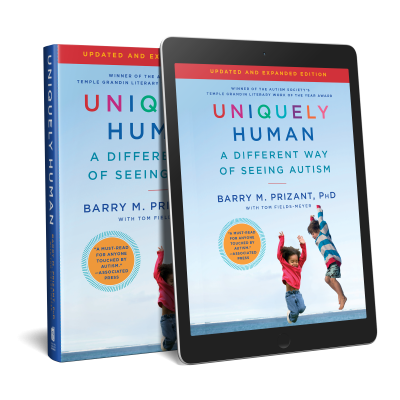
Uniquely Human, the book (Updated and Expanded edition!)
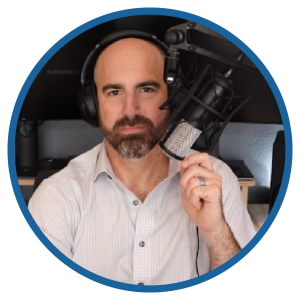
Dave Finch
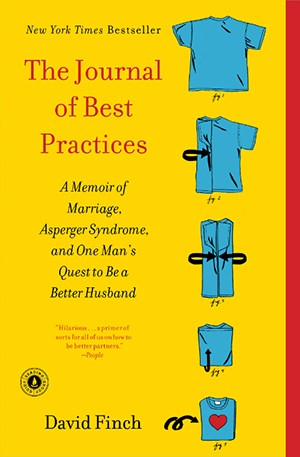
Dave Finch is the author of the New York Times bestselling memoir, The Journal of Best Practices: A Memoir of Marriage, Asperger Syndrome, and One Man’s Quest to Be a Better Husband. As a writer and creative consultant, his work has appeared on ABC, CBS, NBC, CNN, NPR, SiriusXM, The New York Times, Rolling Stone, The Howard Stern Show, and the award-winning Netflix series, Atypical. Based in Denver, Dave’s company, Elevated Studio, produces this podcast and other recognized series.
Visit Dave’s website here
“I have read a million and one books on Autism. Uniquely Human is the best book I have ever read, hands down. Thank you Barry for this incredible gift!!!!”
– Navah Paskovitz, Mother of three boys with Autism, Co-Founder, the Ed Asner Family Center
“Compassion, learning and supportive strategies–the three essentials for working with folks with ASD–are an integral part of this must-read book.”
– Michelle Garcia Winner, Speech Language Pathologist and Founder of Social Thinking
“Thanks be to Barry for the first-ever must read written for parents, educators, and clinicians.”
– Michael John Carley, Founder, GRASP; Author of Asperger’s From the Inside-Out
“What makes the book compelling is how funny Mr. Finch is about himself. He’s great company.”
– Susannah Meadows, The New York Times
“In this hilarious memoir (which also gives some of the finest explications of Asperger’s out there), Finch approaches trying to be a better husband and father with the determination of Sherman marching on Atlanta.”
– Judith Newman, People (4/4 stars)
“Talk about being on a roll. This dude wrote a book, he has Asperger’s syndrome. He cured himself by listening to me on the radio!”
– Howard Stern