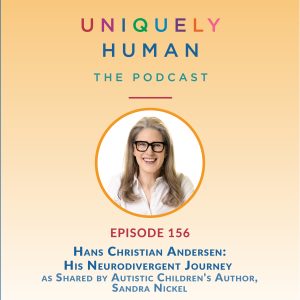
EPISODE 156
Hans Christian Andersen: His Neurodivergent Journey
as Shared by Autistic Children’s Author, Sandra Nickel
Play the Episode…
Show Notes
It is now widely accepted that Hans Christian Anderson, renowned Danish author of children’s books, was autistic. Sandra Nickel, an award-winning and autistic children’s author brings Andersen’s story to life in a beautiful book, “The True Ugly Duckling”. Sandra, Barry and Dave discuss her motivation for writing her book, and the special qualities of his life’s journey that can be so enlightening and affirming for children, adults, and all people who have, or who even may not have neurodivergent individuals in their lives.
Featuring

Sandra Nickel
Sandra Nickel is an award-winning author of picture books. She has received numerous honors: the Christopher Award, Society of Children’s Book Writers & Illustrators Crystal Kite Award (a two-time winner) a finalist for the Golden Kite Award for Nonfiction for Younger Readers, a Junior Library Guild Gold Selection honoree, and a Charlotte Huck Award Recommended author. She holds an MFA in Writing for Children and Young Adults and has presented workshops on writing for children and young adults throughout Europe and the United States. Her most recent book is “The True Ugly Duckling”.
To learn more, visit sandranickel.com.
Uniquely Human: The Podcast
EPISODE 156
HANS CHRISTIAN ANDERSEN: HIS NEURODIVERGENT JOURNEY
AS SHARED BY AUTISTIC CHILDREN’S AUTHOR, SANDRA NICKEL.
🎙️ Transcript and Audio Usage Disclaimer
© 2026 Uniquely Human: The Podcast. All Rights Reserved.
The contents of this podcast, including all audio recordings, transcripts, and related materials, are the intellectual property of Uniquely Human: The Podcast and its fiscal sponsor, Community Autism Resources, a registered 501(c)(3) nonprofit organization.
These materials are provided solely for personal, educational, and non-commercial use.
No portion of the podcast audio, transcript, or any derivative materials may be reproduced, redistributed, modified, or publicly displayed without prior written consent from Uniquely Human: The Podcast or its authorized representatives.
Transcripts are provided for accessibility and reference purposes. They may contain minor transcription or formatting errors. When quoting or referencing the podcast, please credit Uniquely Human: The Podcast and provide a link to the original episode page.
By accessing or downloading transcripts, you agree to comply with this usage policy and acknowledge that all copyrights, trademarks, and intellectual property rights remain the exclusive property of Uniquely Human: The Podcast and its creators.
For permissions or inquiries, please contact: 📧 uniquelyhumanpodcast@gmail.com
Show Disclaimer
[00:00:00] UHP: The primary purpose of Uniquely Human: The Podcast is to educate and inform. The views expressed during all episodes are solely those of the individuals involved and do not constitute educational or medical advice. Listeners should consult with professionals familiar with each individual or family for specific guidance.
[00:00:00] UHP: Uniquely Human: The Podcast is produced by Elevated Studio. Music is graciously provided by Matt Savage of Savage Records.
Meet the Hosts
[00:00:39] Barry: Hi, I’m Dr. Barry Prizant, clinical scholar, researcher, and consultant on autism and neurodiversity, and a Brooklyn boy raised in the big city.
[00:00:49] Dave: And I’m Dave. I’m none of those things, and I grew up on a farm in Illinois. But being on the spectrum myself, I have plenty of personal insight to lend.
[00:00:59] Barry: And this is Uniquely Human: The Podcast, a show that illuminates and celebrates autism and neurodiversity.
Introducing Sandra Nickel
[00:01:13] Barry: Today on Uniquely Human: The Podcast, Dave and I have a guest that we’re very excited to speak to, in terms of her enthusiasm and her work. And that is Sandra Nickel. So Sandra, welcome.
[00:01:28] Sandra Nickel: It’s a pleasure to be here. Thank you so much for inviting me, Barry.
[00:01:32] Barry: Oh, sure. And I’m going to tell you a little story. A few months ago, I was traveling in California, a little bit north of Santa Barbara. We went to this wonderful Danish-inspired town called Solvang, and I went into a museum that was upstairs from a bookstore — a museum about Hans Christian Andersen. And then one thing led to the next, and we found out that Sandra had written a book — a wonderful book for children, but actually for everybody — about Hans Christian Andersen. And that’s what we’re going to be talking about today. So Sandra, if you would tell us a little bit about your personal and professional journey, and then I’ll share a little bit more about you.
Sandra’s Journey: From Law to Writing
[00:02:28] Sandra Nickel: Sure.
[00:02:30] Sandra Nickel: So I only learned a few years ago that I was autistic. For most of my life, I didn’t know. And so, like a lot of girls, I masked a lot. And I was trying to live up to other people’s expectations. So I did a lot of different jobs and ended up at a giant New York City law firm, where I was quite miserable — and ended up in a hospital, where they said I had an undiagnosable disease. My symptoms at that time were that I couldn’t digest anything. I couldn’t eat anything. I could only drink clear fluids for six weeks after they released me, and I was just completely exhausted.
[00:02:30] Sandra Nickel: But then when I got over that, I still didn’t quite get the message from my body. And then I just had nonstop migraines — I’d go to sleep with them, I’d wake up to them. And I went to a neurologist and he said: “I know where you work. Do you like your job?” And I said: “No, not really.” And he said: “I recommend that you quit.” And so I did. And now, looking back and knowing that I am autistic, I think it was just me trying to find myself in all the wrong places.
[00:04:10] Barry: But Sandra, you eventually moved out of the bad situation. And let me just share some of your achievements here. You are an award-winning author of picture books. You’re the winner of the Christopher Award and a two-time winner of the Society of Children’s Book Writers and Illustrators Award. My goodness. You found the right path, right? An MFA in writing — and I don’t know if that happened after the law firm situation, but you obviously found the right path. So how did that happen, and how did that get you to Hans Christian Andersen?
Finding Writing Through Motherhood
[00:04:51] Sandra Nickel: Yeah. It really was only when I had my daughter, and she was someone who said “tell me a story,” not “read me a story.” So I was always telling her stories, and then at one point I just clicked and I thought: wow, a lifeline of mine has always been reading — why don’t I start writing stories for children? And that’s when I got my MFA, and that’s when I started writing.
[00:04:51] Sandra Nickel: And then fast forward to my daughter going to college. When she went to college, she found out she was autistic. And after she found out she was autistic, she turned to me and she said: “And now you, Mom.”
[00:05:38] Barry: Daughter diagnosed his mom.
[00:05:40] Sandra Nickel: Yeah. Daughter diagnoses mother.
Discovering Hans Christian Andersen
[00:05:43] Sandra Nickel: And of course, I was autistic too, and I started reading everything I could.
[00:05:52] Sandra Nickel: And during that reading, that’s when I found out about Hans Christian Andersen being on the spectrum. And he had said that “The Ugly Duckling” was the story of his own life. And when I read those two things, I thought: wow, of course. The story of “The Ugly Duckling” is really the story of every neurodivergent child or person trying to find their place in the world. And as soon as I had that thought, I knew — it was just like a big push. I felt obligated to write this book.
Andersen’s Fairy Tales and Neurodivergence
[00:06:29] Barry: So I don’t want to assume that everybody knows of Hans Christian Andersen. Could you summarize some of his achievements, and when you really dove in, what were you just so taken by?
[00:06:53] Sandra Nickel: Yeah. So, well, Hans Christian Andersen — even if people think they don’t know him, they do know him. He wrote “The Little Mermaid.” He wrote “The Snow Queen,” which Disney has taken both of those and made into epic stories — The Snow Queen became “Frozen,” and of course The Little Mermaid became “The Little Mermaid.” But other iconic stories that are really part of everyone’s growing up — “The Princess and the Pea,” “The Emperor’s New Clothes,” “Thumbelina,” “The Little Match Girl”… He wrote many. Yeah, he wrote many fairy tales. And of course they have become operas, plays, and films too.
[00:07:40] Dave: You know, my wife calls me the princess and the pea, because there are so many variables for me to get comfortable and they all have to be perfect. But please continue.
[00:07:55] Sandra Nickel: Yeah. No — one of the things I thought was so interesting, once I knew that Andersen was neurodivergent, was to look at his stories and realize how the theme of so many of them is being different. And even “The Princess and the Pea” — I don’t think a lot of people maybe remember that she was the one who was different. But how they knew she was different is that she woke up in the morning completely blue and bruised all over her body from this pea under the mattress, which is such an autistic story right there — because so many autistic people, of course, are hypersensitive to things. And that’s so funny that you were “The Princess and the Pea!”
[00:08:44] Dave: I am. She just referred to it a couple of nights ago, actually, because I wanted the heating pad on my shoulders just to loosen my muscles a little bit. But I didn’t like the fabric cover that was on the heating pad, and it was a whole ordeal to find a solution. So Kristen was like: “All right, Princess and the Pea, are you ready to watch TV with me yet?”
Bullying and Paper Cuttings
[00:09:06] Barry: Yeah. One of the things that’s so special about your book — which is called, I don’t know if you said it yet: “The True Ugly Duckling” — a lot of things are very special about it. The illustrations are amazing, and of course the story is amazing. But you follow his journey. And like you said, it’s the story of so many neurodivergent people.
[00:09:31] Barry: So why don’t you share a little bit about what it was like — what his mother thought about him, how people treated him when he was young?
[00:09:40] Sandra Nickel: Yeah. I think it’s always so interesting to me that there’s still this belief that some people have — that autistic people are unemotional. My experience is that autistic people have these giant, tender hearts. And that was definitely true about Andersen.
[00:09:40] Sandra Nickel: The town he grew up in — the boys were rough. They were either working in factories or going to school, and that was just too much for him. He stayed at home. He made up stories. He had a scissors and cloth — there was a textile industry in the town he was growing up in, so there was cloth available — and he would cut shapes and costumes for the stories he would make. And then he would go out and he’d want to share these stories with whoever he could find — the kids on the streets, people in the factories — and they just ridiculed him. They thought he was just this strange kid, and nobody really wanted to have much to do with him.
[00:10:52] Barry: A story of bullying.
[00:10:53] Sandra Nickel: Yeah.
Self-Regulation and Paper Cutting
[00:10:54] Barry: Yeah. Unfortunately. Wow. I’m going to add a little out-of-left-field clinical note here. The way you describe him in the book with his paper cuttings — the clinical term for that would be: that was a self-regulatory strategy for him, right?
[00:11:18] Sandra Nickel: Yeah.
[00:11:19] Barry: He soothed himself. That’s what he could go to. And it ended up being an incredible talent as well.
[00:11:26] Sandra Nickel: Yeah. And it’s a talent not a lot of people know about. I think at the museum you went to — did they have some of his paper cutouts there?
[00:11:35] Barry: Yes. They had a whole display of the paper cutouts.
[00:11:38] Sandra Nickel: Yes. And they’re amazing. Even the Metropolitan Museum of Art — you can go online and you can find one of his. He did them in the way where you would take a piece of paper and fold it over — like how we used to do the snowflakes when we were kids.
[00:11:54] Dave: Yeah.
[00:11:56] Sandra Nickel: Yeah. That’s how he would do it. But his are at a completely different level. But you’re right, Barry. That’s exactly what they were.
Fame, Overwhelm, and Masking
[00:12:05] Sandra Nickel: So he had this whole journey. He so desperately wanted to be a story maker — whatever that might be — and he tried it in a bunch of ways. And he finally landed on writing fairy tales. And once he hit that place, he became relatively popular, pretty quickly. And he was invited to castles by duchesses and queens, and they would have these outings where all this nobility would come — maybe for three or four days — and they would want him to stand up and tell his stories to whoever was there. And of course he was honored by this, but it was also completely overwhelming for him. He felt out of place, of course. He grew up in poverty, and so when he would have to stand up, he always carried scissors and paper with him. And so as he stood up to tell his stories, he would cut out shapes. And that’s how he soothed himself — he had something to focus on other than all of these people staring at him, all this nobility, these very wealthy people.
[00:12:05] Sandra Nickel: And I think it’s great that during his lifetime, people actually collected these cutouts too. So it became — he had all this positive reinforcement for something that soothed him.
[00:13:45] Dave: It occurs to me too that — I’m far from being Hans Christian Andersen, but I do travel, and I’ve got my very controlled little system for how I travel. Barry has seen me wiping down the insides of cars and hotel rooms with Lysol wipes and getting everything arranged the way I’m going to be comfortable for a few nights. And I just think: what travel looked like in his era, I can’t imagine how dysregulated — at least if I like Cheez-Its at home, I can find Cheez-Its at a local Target and eat them when I’m traveling. Back then — you’re leaving everything from your context and you’re going to a completely different new set of foods, smells, on top of the social pressures. It’s remarkable.
[00:14:40] Sandra Nickel: It is remarkable. And he was, of course, masking. Like, one of the conundrums he was always in was: he was invited by these very wealthy people, but he felt like he couldn’t say no. And sometimes he didn’t even really have the money to pay for the journey to go be with them. But he would never — some people said: “Why don’t you ask the king? Just tell the king that you don’t have enough money.” But he didn’t want to. It was embarrassing for him. And on top of everything else, he had these kinds of anxieties going on.
[00:15:19] Barry: Yeah. What comes to mind — and we see this in so many ways — is that in the arts, if you’re seeing an artist, it’s okay for them to appear, in conventional terms, a bit eccentric or a bit different. It’s almost like our societally conditioned response loosens up a little bit when we see somebody who’s very creative, especially if they enjoy sharing their talents and their creations with others. So I’m just trying to visualize him preparing to tell a story, with his scissors and his little cutouts — a very productive fidget strategy, and more so than most fidgets. And I believe you had mentioned also how children responded to him in particular.
Rejection Before Breakthrough
[00:16:25] Sandra Nickel: Yeah. And I think that’s one of the really great things because — so he went to Copenhagen. He had this vision, he wanted to do something creative, and as I said, it could be anything. Since he’d been making up plays and doing plays in his village, that’s the first place he went. He goes to the playhouse and says: “I want to be an actor.” And they’re like: no, move on. And then he next went to the ballet school and said: “I can be a dancer.” And the same thing: no, you’re not good at that, move on. It’s interesting to me because these were creatives too — even the creatives were saying: you don’t belong here.
[00:16:25] Sandra Nickel: And then he went and started — he went to a boys’ choir and actually had a quiet, beautiful high voice, but then his voice changed, and so that didn’t work out either. And it was really only when he started writing fairy tales that he started to get some positive feedback. And that came from children. The adults were still like: these are strange stories. But the children — they loved him. And then the more the children loved them, the more he wrote. And as he wrote more, the adults came around too — as you saw, the kings and queens and countesses also fell in love with his stories.
[00:17:58] Barry: So initially he was a bit of a pied piper. I could just see —
[00:18:02] Sandra Nickel: Yeah.
[00:18:02] Barry: Children gathering around. And it’s interesting because my co-author of Uniquely Human, Tom Fields-Meyer, his son Ezra has that interest and that talent — he loves it. In Los Angeles, he goes to a number of different places, the Los Angeles Zoo and libraries, and he reads to the kids and the kids just gather around him. Tom always sends me pictures of Ezra — who’s now close to 30 years of age — with all of these kids surrounding him. I could just imagine the same thing with Hans Christian Andersen.
[00:18:37] Sandra Nickel: Yeah. It’s a gift. Although he said: “My stories are for everyone.”
Mentors and Affirmation
[00:18:42] Barry: Yes. One other thing that struck me as I read your book had to do with people rejecting him or mocking him — but then there were breakthroughs. And when you say it’s so often the story of neurodivergent and autistic people in general — we’ve known people. The story of Temple Grandin is Mr. Carlock in high school saying: “Wow, what you have going here is very special and I will help support that.” And you bring that up in the book.
[00:19:25] Sandra Nickel: Yeah. There’s this really great moment. As I said, he went from trying to act, to trying to dance, to trying to sing. And he had completely run out of money at this point. And he was like: I’ll just try writing a play. And he sends this play to two directors of the theater. And one of them says: “Never, ever will this play be made.” But the second one saw some jewels in the play. And I think what’s amazing about that is — he’s the first person who didn’t say: move on. He said: let me help you get the tools you need so that you can do what you want. And he sent him to school.
[00:19:25] Sandra Nickel: And that was a traumatic experience, because by that time Andersen was 17 and here he is in school with all these young boys. He’s tall, he’s bigger than everybody, he has a rather prominent nose, he’s trying to learn everything these kids are learning, and he’s 17. It was a difficult situation. But the same man wrote him letters, invited him to his home, and — do you know what it was? Affirmation of his dream. And giving him tools so that he could reach that dream.
[00:20:56] Dave: It just takes the one angel to unlock all of this — and to create an environment that nourishes this sort of othered, outsider person. And like you said, equip them. Give them the tools so that they can stand on their own.
[00:21:20] Sandra Nickel: Yeah, it’s so true. The illustrator of the book that came out before this one of mine — it’s called “Seven: A Remarkable Pigeon” — said she wasn’t the most talented artist in her class, but the teacher said to her: “Wow, you are an artist.” And it was such a big affirmation for her that she was like: yes, I am. And she just kept on going. She’s a very talented artist. But so much comes from that belief.
[00:22:10] Dave: And also these things are subjective. You can say someone’s the best at math because their equations are always right, but to say you’re the best artist — that’s so subjective. You just need to be the right artist for the story and for the audience. That’s it. You don’t have to be Mozart — you just have to have an artistic vision that is something you want to compose.
[00:22:40] Sandra Nickel: Yeah. So true.
[00:22:42] Barry: And I think — I might be wrong in saying this — but I think that idea of having, whether it’s a mentor who actually is with you or just people who believe in you, seems to be so much more important for people who’ve been marginalized, because they’re getting a lot of negative messages in their life, especially from very early on. And, I don’t know how toxic it was — if it was toxic at all — but for Hans Christian Andersen, his mother referred to him as a “strange child.” And then to have people come along and say: you’re different, here’s the potential I see in you, and I believe in you — that’s remarkable. And that comes out of many of the stories of our guests on this podcast: if somebody believes in me, then I guess there’s something in me that is worthwhile believing in.
[00:23:43] Sandra Nickel: Yeah. No, it’s such a big gift to give to another person — to believe in them, and to believe in their dream, and to believe in what they’re doing. It’s incredible.
[00:23:58] Barry: So special for him.
Adversity and Creative Genius
[00:24:00] Barry: So that actually leads me to something I was wondering about. Do you think the adversity that he faced in his life for all those many years, up through his teen years — is there a direct link to his genius, a direct link to his eventual recognition?
[00:24:27] Sandra Nickel: I think absolutely. I think he couldn’t have written the stories he wrote without going through the adversity that he went through. I don’t think he could have written the story of “The Little Mermaid” or the story of “The Ugly Duckling” — both of those are just born so much out of the difficulty, the yearning to be accepted, the yearning to find his place in the world. I think absolutely that came out of his lived experiences.
[00:25:11] Barry: And probably quite therapeutic for him. Maybe it isn’t that he thought: oh, I’ve gone through this in my life, now I’m going to write a story about it so other people can look at this differently. Maybe just putting it down there — and I’m not a fiction writer, but just putting it down there and being able to express what you’ve gone through helps you have some peace with that.
[00:25:40] Sandra Nickel: Yeah. That is absolutely true. That is so true.
Writing as Therapy and Unmasking
[00:25:44] Sandra Nickel: And I think — yeah — I never read that he purposely wrote this story about himself. I think, at least thinking about how things work for myself, I sometimes think I’m writing a fiction story and then I finish it and maybe two years later I look at it and go: oh, that’s funny. That’s my story.
[00:26:09] Dave: Yeah. I had that experience writing my book, which is a memoir — so it’s creative nonfiction — and the creative bit of it was the storytelling approach and crafting it. But really it started with an exercise in free therapy. I had just been diagnosed with Asperger’s syndrome and this was 2008 or something, and I was just starting to write about it to make sense of it in a way that I could contain the information. My way to understand it was through humor. So I was writing humor essays about being the fish out of water and this and that — very literal about my life — and just seeing for myself what was funny about it, what was challenging about it.
[00:26:09] Dave: And I quickly learned that the less protective I was — basically the more willing I was to dive into the really difficult emotional stuff — the better the writing was, because it was more therapeutic. And I think you have to be the story in a first draft. Whatever the story is — a play, a book, an article — has to be very meaningful to the author. Then the second draft is about making it for public consumption: maybe other people need to read this now, so I’m going to make it more accessible, or less self-indulgent. But really that first pass — you get the sense that the Hans Christian Andersens of the world become who they are because what they’re writing from is a place of absolute truth, even though it’s fiction.
[00:27:54] Barry: Well said.
[00:27:55] Sandra Nickel: Absolutely. Yeah.
[00:27:57] Barry: So that really takes us to the consideration of the impact that Andersen had on your writing. When you reflect back on not only this work, but how it has helped you evolve and shaped you as a writer.
[00:28:19] Sandra Nickel: It’s so interesting. Thank you for asking that question because it really did have a big impact on me. When I was assessed, my assessor said: “You have been masking so heavily, and for so long, I’m not sure you were ever going to be able to be the person you were supposed to be.”
[00:28:43] Barry: Oh, what? That’s a heavy message.
[00:28:45] Sandra Nickel: Yeah. And that was pretty heavy. And so when I was reading Andersen — after I found out about him being on the spectrum — I was really struck by how he focused on differentness in his stories, how he just put it out there. And I decided then that I was going to do my best to stop masking as much as I could, and to stop masking in my writing. And that’s of course when I decided to write the story of Hans Christian Andersen.
[00:28:45] Sandra Nickel: But at the same time, I was also writing the pigeon story — “Seven: A Remarkable Pigeon” — which is really based on my experience growing up, and also my daughter’s experience, about going back to maybe some of the hyperfocusing thing: about noticing the beauty in our world that maybe a lot of people don’t notice. And it makes you different, but it also gives you all this joy. And in this story it also allows Seven to become the hero who saves everybody. But it all goes back to noticing how Andersen used differentness in his stories — and just owning that.
[00:30:25] Barry: So is your daughter a fan of Hans Christian Andersen?
[00:30:28] Sandra Nickel: Yeah, she is. She’s always been a big reader. She loves fairy tales.
The True Ugly Duckling: Paper-Sculpted Illustrations
[00:30:39] Barry: So what do you hope that readers will take away from “The True Ugly Duckling”? And let me emphasize again — as beautiful as the story is that you’ve written, it is visually beautiful.
[00:30:53] Sandra Nickel: Oh, the book — Kelvin Nichols did an outstanding job. So for the listeners who can’t see the cover — Arthur Levine, who is our editor, chose a paper-cut artist to illustrate the book, to mirror Andersen’s paper cutting. How fitting. And he did a really outstanding job.
[00:31:22] Barry: And when you turn the pages and look at them, it’s almost three-dimensional.
[00:31:28] Sandra Nickel: It is —
[00:31:28] Barry: It comes out at you. And I had to rub it to make sure it wasn’t intentionally lifted off the page the way it was designed — that it wasn’t.
[00:31:40] Dave: I did the same thing. I opened it and I thought — oops, I wasn’t expecting it to leap out at me. And then I was like: that is two-dimensional. It’s not leaping out at me.
[00:31:49] Sandra Nickel: Yeah. Kelvin calls himself a paper sculptor. And it’s true. The last time I was exchanging emails with him, he talked a little bit about how he photographed it and how he has to play with light to get it to do exactly what you said — have those shadows, so it really looks like it’s jumping off the page.
[00:32:16] Dave: Yeah.
[00:32:16] Sandra Nickel: Oh, Dave’s showing it there.
[00:32:20] Dave: This is just incredible. Yes.
[00:32:23] Sandra Nickel: Dave, have you taken off the cover?
[00:32:27] Dave: I have not. Oh, that’s crazy. Okay, so — I know this is an audio medium — but I thought this was a textured three-dimensional cover. And again, it’s 2D under the dust jacket.
[00:32:44] Sandra Nickel: Yeah. So for people listening: the dust jacket has the title “The True Ugly Duckling” and there’s a picture of a young boy with two swans, as a nod to the end of his journey. And then when you take that off, you see a paper cutting — like the ones we were talking about, the folded kind — underneath. Yeah. No, it’s really beautiful.
[00:33:14] Barry: And it’s interesting how, being a paper-cutting artist, the person who did the artwork thinks in three dimensions but makes it two-dimensional — and yet he has the ability to think in three and have that come right out at you.
[00:33:35] Sandra Nickel: Yeah. Awesome.
What Readers Should Take Away
[00:33:36] Barry: So what do you hope readers will take away?
[00:33:39] Sandra Nickel: Yeah. I guess since I grew up masking so much, I have a big hope that when people read it, they will pay attention to how Andersen had — he really had this heart’s desire to be a storyteller, whatever that would be. And he became that in the end, even though there were a lot of doors shut in his face on the way to that. And I’m really hoping that when people read it, they go: oh wow, okay, he made it — I can make it too. I hope that they pay attention to what their heart is really telling them. And also for the ones who are struggling with being different, I hope that they see that their originality can also be a gift — their originality can be their path forward, their way of becoming the swan they were supposed to be.
[00:34:46] Barry: Yes. Beautifully stated. And we share that hope with you. One reason we’re doing this podcast — Sandra, thank you so much. It was just wonderful talking about your work. And of course we will have a link to where it can be purchased on the webpage for this episode, so people can experience firsthand the beauty of the writing and the physical beauty of the book as well.
[00:35:18] Sandra Nickel: That’s very kind of you. Thank you very much.
[00:35:21] Barry: Sure.
Closing Thoughts
[00:35:23] Barry: Any parting words, Dave?
[00:35:27] Dave: Just get the book. And I will say — it’s so funny — when you first brought up this whole topic, Hans Christian Andersen, I thought: okay, cool, basically whatever Barry says he wants to do for the podcast, I go with it, ’cause he’s never wrong. And I was like: all right, great. And then once I started to actually do the research ahead of the interview, I was like — what? This guy’s my hero. Basically he managed to accomplish everything that I would’ve accomplished, perhaps, if I were more courageous and more willing to just go all in on the creative visions I had when I was younger — and not saddle myself with a mortgage and car payments and school loans and all that stuff.
[00:35:27] Dave: So it’s just remarkably inspiring. And I often invoke my own kids in some of these types of conversations, but this very much also reminds me of my daughter who — after all those episodes of hemiplegic migraines and the serious digestive problems that were shutting down her organs, which was terrifying — has decided: you know what, I’m going to pursue improv, writing, and acting. And she’s doing that right now instead of going into the pre-medical track. And she is just thriving. It’s wonderful to see her shining in this way. And this gives me the parental encouragement to be able to pass this along to her and say: hey, you’re in good company.
[00:37:06] Sandra Nickel: Yeah. Ah, this is everything I love to hear. This is —
[00:37:11] Barry: And —
[00:37:12] Sandra Nickel: Tell her congratulations. I’m so proud of her.
[00:37:15] Dave: I am too. I will. Thanks.
[00:37:17] Barry: And let her be your mentor, Dave. And you need to post your paper-cutting tour as you begin to go around the country.
[00:37:28] Dave: People don’t understand what a good paper cutter I am. I’m also an extremely good line cutter — so if I need to get ahead in the line at Starbucks, I’ve got any number of devices I can use to wiggle my way up to the front.
[00:37:41] Barry: And on that note, I think we will thank Sandra once again for this wonderful discussion. And please, listeners — get the book. I mean it. It’s just wonderful for everybody.
[00:37:53] Dave: Wonderful job. Excellent. Thank you.
[00:37:55] Sandra Nickel: Thank you. It’s just been so much fun talking to you guys. Thank you so much.
[00:38:00] Barry: All righty. Bye-bye.
[00:38:01] Sandra Nickel: Okay. Bye-bye.
…and Continue the Discussion
Do you have a book or podcast club? If so, you may use this discussion guide to facilitate a conversation about this episode.
1) What in Sandra’s personal life and journey let her to write a children’s book about the life of Hans Christian Anderson? Does what she discusses with Dave and Barry resonate with you as a neurodivergent individual, parent, or a person in relationship with a neurodivergent individual?
2) As Sandra discusses some of the most famous works of Hans Christian Anderson, what are some of the common experiences from his life to the lives of most neurodivergent children that she feels would be helpful to them?
3) What does Sandra feel are the most remarkable contributions and messages of Hans Christian Andersen’s body of work for children, families, and society? Any other contributions that you feel he has made in sharing his talents to the world?
HOSTED BY

Barry Prizant, Ph.D., CCC-SLP
Dr. Barry Prizant is a speech-language pathologist with more than 50 years experience as a researcher and international consultant for autistic and neurodivergent individuals and their families. He is an Adjunct Professor of Communicative Disorders at the University of Rhode Island and Director, Childhood Communication Services (a private practice). Previously, he served as Associate Professor in the Department of Psychiatry in the Brown University School of Medicine, and held a tenured professor appointment at Emerson College. Publications include 5 books, most notably Uniquely Human: A Different Way of Seeing Autism (2015; 2022) and The SCERTS Model manuals, an educational approach implemented in more than a dozen countries. He has published 150 scholarly chapters and articles and serves on numerous professional advisory boards for journals and professional organizations. Barry has presented more than 1000 seminars and keynote addresses internationally, including two invited presentations at the United Nations for World Autism Awareness Day. His career contributions have been recognized with honors from Brown and Princeton Universities, the Autism Society of America and the American Speech-Language-Hearing Association.
Visit Barry’s website here
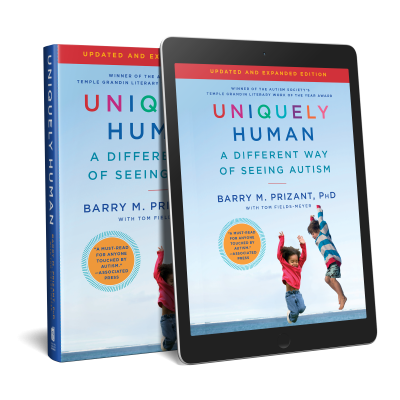
Uniquely Human, the book (Updated and Expanded edition!)

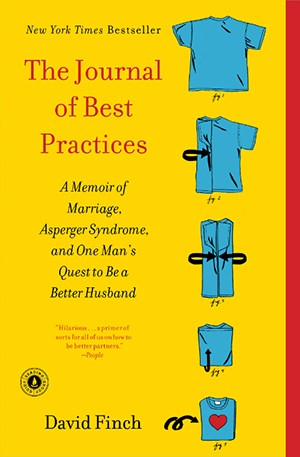
Dave Finch
Dave Finch is the author of the New York Times bestselling memoir, The Journal of Best Practices: A Memoir of Marriage, Asperger Syndrome, and One Man’s Quest to Be a Better Husband. As a writer and creative consultant, his work has appeared on ABC, CBS, NBC, CNN, NPR, SiriusXM, The New York Times, Rolling Stone, The Howard Stern Show, and the award-winning Netflix series, Atypical. Based in Denver, Dave’s company, Elevated Studio, produces this podcast and other recognized series.
Visit Dave’s website here
“I have read a million and one books on Autism. Uniquely Human is the best book I have ever read, hands down. Thank you Barry for this incredible gift!!!!”
– Navah Paskovitz, Mother of three boys with Autism, Co-Founder, the Ed Asner Family Center
“Compassion, learning and supportive strategies–the three essentials for working with folks with ASD–are an integral part of this must-read book.”
– Michelle Garcia Winner, Speech Language Pathologist and Founder of Social Thinking
“Thanks be to Barry for the first-ever must read written for parents, educators, and clinicians.”
– Michael John Carley, Founder, GRASP; Author of Asperger’s From the Inside-Out
“What makes the book compelling is how funny Mr. Finch is about himself. He’s great company.”
– Susannah Meadows, The New York Times
“In this hilarious memoir (which also gives some of the finest explications of Asperger’s out there), Finch approaches trying to be a better husband and father with the determination of Sherman marching on Atlanta.”
– Judith Newman, People (4/4 stars)
“Talk about being on a roll. This dude wrote a book, he has Asperger’s syndrome. He cured himself by listening to me on the radio!”
– Howard Stern