EPISODE 145
Connecting with Young Children through Sensoriaffective Integration:
A Discussion with Dr. Carrie Alvarado
A Discussion with Dr. Carrie Alvarado
Play the Episode…
Show Notes
As an occupational therapist with expertise in child development, Dr. Carrie Alvarado has the unique ability to discuss interrelationships between sensory processing and the development of trustworthy connections with young children. Carrie, Barry and Dave explore the implications of “sensoriaffective” integration in supporting parents of young neurodivergent children.
Featuring
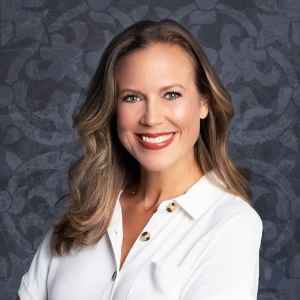
Dr. Carrie Alvarado, PhD, OTR
Dr. Carrie Alvarado, PhD, OTR serves as the Chief Operating Officer and Clinical Director for Autism Community Network (ACN) based in San Antonio, Texas. Carrie has a PhD in Infant and Early Childhood Development with an emphasis on Infant Mental Health and Neurodiversity. Carrie is the creator and director of the Earliest Connections Clinic, a diagnostic program geared toward early identification and therapeutic intervention for infants and toddlers. Additionally, Carrie leads the DIRFloortime and PACT therapy/teletherapy programs- intensive intervention programs supporting families with autistic children through dyadic coaching using both in-vivo and reflective video feedback modalities. Carrie’s primary research interests are in Sensoriaffective Integration and attachment, clinical use of reflective video feedback, and in optimizing parent-mediated interventions via the modality of tele-practice.
Carrie was the first in the United States to become a Pediatric Autism Communication Therapy (PACT) Accredited Practitioner and she serves as an Associate with PACT in the UK. Carrie is a DIR®Floortime™ Certified Expert Clinician, and she serves as an Assistant Faculty for the Profectum™ foundation. She is Core Faculty for the Fielding Graduate School of Psychology and Adjunct Faculty for the University of Texas Health Science Center. Dr. Alvarado is passionate about innovating and expanding the boundaries of our knowledge, and about meeting families and fellow clinicians where they are and empowering them to find the gifts they all have to give.
Learn more about Autism Community Network (ACN)
Uniquely Human: The Podcast
EPISODE 145 – NOV. 21st 2025
CONNECTING WITH YOUNG CHILDREN THROUGH SENSORIAFFECTIVE INTEGRATION: A DISCUSSION WITH DR. CARRIE ALVARADO
🎙️ Transcript and Audio Usage Disclaimer
© 2025 Uniquely Human: The Podcast. All Rights Reserved.
The contents of this podcast, including all audio recordings, transcripts, and related materials, are the intellectual property of Uniquely Human: The Podcast and its fiscal sponsor, Community Autism Resources, a registered 501(c)(3) nonprofit organization.
These materials are provided solely for personal, educational, and non-commercial use.
No portion of the podcast audio, transcript, or any derivative materials may be reproduced, redistributed, modified, or publicly displayed without prior written consent from Uniquely Human: The Podcast or its authorized representatives.
Transcripts are provided for accessibility and reference purposes. They may contain minor transcription or formatting errors. When quoting or referencing the podcast, please credit Uniquely Human: The Podcast and provide a link to the original episode page.
By accessing or downloading transcripts, you agree to comply with this usage policy and acknowledge that all copyrights, trademarks, and intellectual property rights remain the exclusive property of Uniquely Human: The Podcast and its creators.
For permissions or inquiries, please contact:
📧 uniquelyhumanpodcast@gmail.com
Introduction to the Podcast
[00:00:00] UHP: The primary purpose of Uniquely Human: The Podcast is to educate and inform the views expressed during all episodes are solely those of the individuals involved and do not constitute educational or medical advice. Listeners should consult with professionals familiar with each individual, or family for specific guidance.
Uniquely Human: The Podcast is produced by Elevated Studio. Music is graciously provided by Matt Savage of Savage Records.
[00:00:40] Barry: Hi, I’m Dr. Barry Prizant, clinical scholar, researcher and consultant on Autism and Neurodiversity, and a Brooklyn boy raised in the big city.
[00:00:51] Dave: And I’m Dave. I’m none of those things, and I grew up on a farm in Illinois. But being on the spectrum myself, I have plenty of personal insight to lend
[00:01:00] Barry: and this is Uniquely Human: The Podcast, a show that illuminates and celebrates autism and neurodiversity.
Special Guest: Dr. Carrie Alvarado
[00:01:15] Barry: Today on Uniquely Human: The Podcast, we are thrilled to have Dr. Carrie Alvarado with us today. Welcome, Carrie.
[00:01:24] Carrie: Hi there. So happy to be here.
[00:01:26] Barry: Yeah. and this is a very quick follow up because I was able to participate in a conference in San Antonio that Carrie and her colleagues organized. And, it was wonderful. We had some terrific discussions over dinner and at the conference, and I said right away: carrie, we need to have you on the podcast. You have such important information to share.
[00:01:49] Carrie: Very kind. Thank you.
Carrie’s Background and Early Influences
[00:01:52] Barry: So a little bit about you. Dr. Carrie Alvarado, who is an occupational therapist, serves as the Chief Operating Officer and clinical director for Autism Community Network based in San Antonio, Texas.
Carrie has a PhD in infant and early childhood development with an emphasis on infant mental health and neurodiversity. Carrie, I think a lot of people don’t realize is this whole field of infant mental health, it’s not just about us older folks who have to have mental health issues addressed.
Right?
[00:02:26] Carrie: Exactly. Exactly.
[00:02:27] Barry: And Carrie is the creator and director of the Earliest Connections Clinic, the diagnostic program. Geared towards early identification and therapeutic intervention for infants and toddlers. Additionally, Carrie leads the DIR floor time and packed therapy, teletherapy programs, intensive intervention programs, supporting families with autistic children through diadic coaching, both in vivo and reflective feedback modalities.
That’s a mouthful, but we’re gonna unpack it. Carrie’s primary research interests are in sensory affective integration and attachment, clinical use of reflective video feedback, and in optimizing parent mediated interventions via the modality of telepractice. Carrie was the first in the United States to become a pediatric autism communication therapy or PACT accredited practitioner, and she serves as an associate with PACT in the uk. Carrie is a DR Floor time certified expert clinician and is an assistant faculty for the Pro Factum Foundation and Core faculty for the Fielding Graduate School of Psychology and adjunct faculty for the University of Texas Health Science Center.
And one thing that people are gonna see right away is your passion about innovating and expanding the boundaries of our knowledge. And about meeting families and fellow clinicians where they are and empowering them to find the gifts they all have to give. So I’m gonna hand it over to you, Carrie, and maybe fill in some of the gaps, in terms of your personal and professional journey and how you became focused in your current work.
[00:04:12] Carrie: Yeah. Thank you so much for that introduction. Lots of different hats that I get to wear, but it is really driven by, some really early life experiences that I had. I think my curiosity about different ways that people experience the world, and the impacts of these differences on relationship really come from a relationship that I had in my childhood with my aunt Jenny. My aunt Jenny was born with Down Syndrome. She was my mom’s youngest sibling. And I grew up in the context of her being in our home, in our family. She was non-speaking. she had lots of different intellectual challenges. And so I was very intrigued early on about her inner experiences. I noticed that Jenny would very frequently become overwhelmed by the world around her.
I noticed that her family and the people that she was interacting with really seemed to matter, in her level of comfort in navigating the world. And so I think very early on I was taking data on How do family relationships work and why is this world and this room and this experience really overwhelming to Jenny right now?
I was really very curious about, her inner experience and it led me into wanting to be a helper in some field. It took me a while to find ot. but once I did, I really realized that, my role. Could be to support families and to support lots of different people like Jenny earlier than I met Jenny.
Jenny was probably in her twenties, by the time I came around. She was born in the fifties, a time in which a lot of doctors told my grandma, just go ahead and put her in an institution and protect her siblings, and the normalcy of your family, quote unquote. And my grandmother was Originally pretty much a badass. And she decided that she wasn’t going to do that. She was gonna keep fam Jenny in the context of our family. And that really made all the difference in my developmental trajectory. And I think, the cohesivity of my family union.
So I got into OT, and I started out and working with adults and really noticing how important the family system was even in working with adults to motivating and supporting someone through a recovery.
And pretty quickly after I got into pediatrics, started to work with children, and I started to recognize pretty quickly that the autistic children that I was meeting were really needing some additional support from me. I needed a little bit more than what I’d learned in OT school in order to tap into supporting them and connecting with them.
And so that’s really when I initiated my DAR training in 2004. In 2008, I found out about the ICDL graduate school that was gonna be opening up the PhD program. And I enrolled to be in the first cohort of that program. Began my DAR training and then after several years about nine of that PhD program, I started my dissertation and started really looking at parent mediated approaches for supporting children with autism.
And I, found PACT intervention, pediatric Autism Communication therapy, and I said, I have to be trained in this model. DIR really provided me with a map to follow in terms of supporting children and understanding their unique individual differences. But I needed an additional layer of support to understand how to support parents and to have a map in regard to providing facilitation, and connection for them to, support their child’s social communication.
[00:08:00] Dave: And that almost seems like the trickiest part, I would imagine is, like you have this entire background that informs how you’re going to interact with a pediatric patient. But educating the parents and getting your knowledge transferred in such a way that they can keep this a daily sustained thing seems like, probably more difficult than anything.
[00:08:27] Carrie: Yeah. And I think that’s why, for me, I’d done parent coaching for a really long time and supporting parents within a gym environment when they would come see me as their clinician. And, my initial format of coaching was, let me jump in and model something for you mom and dad, and now you imitate me. And it just didn’t feel very productive. And also I was getting a response out of the child that very often the parents weren’t able to reproduce. And so for me it became even more essential to pull myself further away from being the actual interactive partner with the child and to serve more of that facilitative role.
And PACT really afforded me the tools to do that because I was able to highlight the moments of success using reflective video feedback. We would go through the video, we’d hone in on those moments where, wow, mom, dad, did you see how he just referenced you? Did you see how he just shared an idea or an interest with you?
What did you do that afforded that moment? How did you know to do that? How did that feel for your child? How did that feel for you? And it allowed us to zoom out and be more meta, and I’m trying to coach the parent in the moment, where they’re feeling anxious and they’re feeling it’s feeling performative, it’s feeling much more authentic.
They’re feeling centered, and they’re able to see themselves and their child through a very different lens that way.
[00:09:49] Barry: And experiencing that success firsthand. As opposed to, as you said, observing maybe a teacher or a therapist and then the parent feeling: “you are the expert, you could do that. I can’t do that.” And, nothing could be more self validating than having that connection experience, right there firsthand. So, let’s really dig in a little bit because, what I didn’t say was, what really made me say to myself, we have to have Carrie on, was observing your presentation a number of weeks ago, and which, also included looking at videos of coaching parents.
Understanding Sensory Affective Integration
[00:10:55] Barry: So some of the foundational concepts that underlay your work, have to do with the connections between sensory processing, sensory experiences, and developing relationships with others, or what you refer to as sensory affective integration. So what are these connections about? Because I think we’ve compartmentalized, you have sensory issues, help a person be less centrally defensive, for example. But the relationship piece is very often left out of that. Go ahead.
[00:11:08] Carrie: Absolutely, yes. Let’s really unpack this because I really become frustrated in this aspect even of some of the occupational therapy work that I see being done traditionally out in the field. So to me the best way to convey this is to really start about a neurotypical baby’s journey from sensing to relating. And how important having adequate sensory integration or sensory affective integration is to that process. so even in utero, a baby’s nervous system is taking data. The data is experienced via all of the senses and this phased integrated stage progression. Every move the baby makes in the utero, the swallowing of the amniotic fluid gives them specific tastes, the contours and the rhythms of hearing their mother’s voice even before they’re born.
All of this is really priming that baby’s nervous system and informing who they’re eventually going to be. I always say development is experience expectant, but I also like to say it’s experience dependent. And I think we could spend an entire podcast just really reveling in the magic of this journey, this sensory journey. But what I really think it’s important for listeners to understand, is that the sensory experience is increasingly multimodal in nature, which means lots of different sensations coming online and being woven together, integrated together in the baby’s brain. And there’s an opportunity for gradual integration in typical neurophysiological development.
So like I said, the baby is really being primed to enter into a world that once they come out here, gonna be really loud. There are lots of sight and sounds and smells and touch and movement and all sorts of different stimuli that are gonna be competing for that baby’s attention. And so the baby’s nervous system upon birth is really, or even prior to birth, really, is it’s starting to attune this baby to this is really important information for me to pay attention to.
And that stuff, that’s really not as important, right? and this is really where I take my hat off to some very inspirational leaders that I have come across in my training and in my work. One of whom is Lorraine Barrick, who is a developmental psychologist at FIU. And then there’s Rosemary White as well, who you might know, who’s a supremely talented ot who really taught me a lot through my DIR training. But what Lorraine Barrick taught me is that we experience the world and ourselves through a collection of a multitude of sensory systems, right? our ability to selectively attend to what is most salient is really afforded to us by what is necessary for our survival initially, right?
And so our experience of sensory integration is shaped by the am modal properties of sensation. And when I say am modal, this is not a modality of sensation. This is a kind of a quality of sensation. What is the rhythm of the sensation? What is the intensity? is there a synchronicity to the sensation?
And she calls the synchronicity, and this kind of binding together of different sensory processes, she calls it inter sensory redundancy. So what we might say, is that, when I jump, I experience simultaneously synchronously my proprioceptive system, my visual system giving, and I’m bouncing up and down for your listeners, I forget people can’t see me, up and down and so I’m jumping and I’m getting this simultaneous prope, proprioceptive input, visual stimulus. Even my auditory system is picking up sounds differentially when I’m in motion like that. To an extent, my interoception system might be giving me some feedback. If my bladder is full, I’m jumping. So all of these different systems are coming in a very zipped up fashion. It’s very organizing input to me. And this is what helps us attune our attention to sensation, is that this information is coming in a zipped up package that’s easier for me to process.
For social encounters, so that was an example of me in motion, right? This is my self-initiated action that a lot of our autistic friends engage in, right? but social encounters are a very different sensory experience. They can be really chaotic. They can bear a lot, many more sensations can be involved with them. There, it’s a less integrated sensory load for us to take in and perceive and make sense of. Sometimes I like to compare this to like a choir. Okay? So you’ve got a choir of different sensory modalities. You’ve got your auditory, your proprioceptive, your vestibular, all of the different senses, right?
And in this case, all of the different, when you’re encountering someone socially, all of the different singers of the choir are singing a different song. It’s not a predictable song that you already know. They might be moving to their own beats. So it’s, not predictable. It’s a higher sensory load.
This is overwhelming to a lot of autistic people, a lot of autistic children, it’s not predictable. Like when I take my school bus toy and I spin the wheels on my school bus toy and I can predict exactly what’s going to happen, right? This social encounter. Includes the sounds, the language, the visual stimulation of the facial expressions, rapid movements that I’m having to track and make sense of, the gestures that we’re using. Just the movement of our mouth, right?
And what can happen for our autistic children is that can cause them. To need to hone in on one part that they’re able to make sense of. And this is sometimes referred to as what we call like piecemeal processing. I might go what we call unimodal on you.
It’s okay, I can’t take in all of you. Let me just look at your mouth as it moves. Does that, yeah. I see you nodding Dave.
[00:17:11] Barry: Carrie, if I could just interject quickly, this reminds me of a quote of one of our previous guests, an autistic woman, Ross Blackburn from England, who states just directly, and it’s one of my favorite quotes “because I can’t predict the behavior of other people very often what they say or do comes across as very sudden and threatening to me”. And so I’m going to just leave that sit for a while because you talk about sensory safety in your work, but that point about other people being very unpredictable is such a salient point.
Parent Coaching and Reflective Video Feedback
[00:17:49] Carrie: Yes, absolutely. The load, it’s about the load and it’s about the complexity and the disorganization of that choir.
And so really some of the key concepts that I like to talk about are how do we intentionally facilitate our signals coming in for the children that we’re supporting being more zipped up in nature. We can calibrate ourselves to provide cues and supports to children that are coming in a much more organized way.
We can orchestrate, and I’m doing a little orchestra motion. We can orchestrate that choir so that they are singing in rhythm with each other so that it’s coming in a more organized way. And when that happens. That cue, that signal is stamped as effectively positive. Oh, that came in. That made sense for me. That didn’t disorganize me. I actually liked it. Might wanna do it again, versus when the choir is singing and they’re all in a different beat. Any of us would probably tune out to the choir and would go back to doing something that was predictable and organizing for us. And so it’s about the positive or negative tag, and that’s the sensory affective component of sensory affective integration.
Is that the way that we support and present our stimulus. To the child, which is really what we’re doing. We’re transferring signals back and forth with one another. As the partner for these children who we know can experience this incoming sensation in a really overwhelming and overloading way like Ros was saying.
We can be really carefully calibrated in the way we deliver that signal so that it affords a child a sense of safety, cohesivity, and organization and predictability. Even if we’re following the child’s lead or what imitating what the child is doing, they know what’s to come and they feel safer in engaging in interactions that way.
[00:19:51] Barry: So let’s take that to the extreme. Just very quickly, if it is not happening that le, let’s say the choir is singing in very, dissonant tones and they’re out of sync and rhythm with each other, if that happens over and over again, this is something that’s you speak about in your work, that there could be trauma out of those situations.
If, because you don’t see the world as. As safe or other people as safe, and so you’re put into a very different mode of existence in your life.
[00:20:28] Carrie: Yeah, absolutely. And sensory trauma is something that seems to be, a bit more of an emergent concept. Really learning as much as I can about it, mostly from autistic adults, who have shared back now, I live in this body that I, a, I can’t always count on my body to cooperate with what I want it to do. And I also live in this world where, guess what? Life is unpredictable, there we can do everything that we want to. Those of us who know and can be allies and can support and look at a sensory surround and think, okay, let’s dim the lights for this child. Let’s not talk. Let’s move slow. Let’s position ourselves, let’s follow their lead purely right? Let’s think about all of the different ways that we can help create a more predictable environment for this child. And then, like I have given in the example before, a firetruck can come racing down the road outside of the room that we’re working on with the child. And there we go again. Everything is back up and we’ve got this, hyper limbic response for this child who’s primed, who’s functioning in that surge capacity state all of the time. And we’ve come into a traumatic situation again, so we cannot always project and, create sensory safety in the world that we live in.
It’s just impossible.
The Importance of Relational Safety
[00:21:48] Carrie: And that’s why I think it’s really, important to understand the importance of the relational safety component, where we can lean in and help to reorganize. That child or help that child really actually even better, learn to advocate for their own sense of organization as they grow and move forward.
[00:22:10] Barry: You talk about the issue of that we, on a neurological basis, we’re all wired for connection. And, when I hear this concept that we are all wired for connection, it strikes me about so clearly about how for so many years, autistic and even some other neurodivergent kids are somehow that wiring is not there or it’s just not possible. Or unfortunately, we need to train connection based upon what we think about how that child needs to behave. That looks like he or she is connecting, like making eye contact, right? Or complying to what we’re saying, for example. So how do you view that discrepancy between that foundational fact and belief that all human beings are wired for connection, but how that really is so inconsistent with traditional views of the autistic experience?
[00:23:15] Carrie: Yeah. I love this question because I really think it gets to the root of how our neurodivergent kids have historically been pathologized and othered and underestimated. This belief or this assumption that they are not motivated or wired for connection, is, has really been perpetuated for decades by our medical model of supporting them.
And so it’s been a real, really a key barrier to presuming their competence, and just intentionally supporting the emotional wellbeing of these children in general. I would say that dispelling the myth has been one that I’ve really been, I’ve tried to be a part of unpacking, for many years.
I think, I learned a lot from my work with Stanley Greenspan, and he was probably the first one who told me that, this is a myth that truly all human beings want, need, and thrive on connection. We may need it to differing degrees from one another, or we may need it in different doses, or we may need it via different modalities.
But we are all uniquely human, after all, as you say. And we honor those differences. But I think it seems like what we may be looking at, in neurodivergent or autistic children is that there’s this static or this noise, this disruption because of their sensory processing differences that really impact those early relational experiences of these children, right? And their ability to demonstrate, their desire to connect. So just learning to make sense of the world is such an effort for them, that often they’re isolating, and withdrawing and becoming a bit more object focused because they’re looking for something that grounds them and anchors them and helps them feel safe, right?
Because these signals are distorted and confusing on both ends. We know that children on the spectrum often have lags in their auditory processing or an apraxic body that isn’t matching what they’re intending to do with it. Or they may have an aversion to looking at faces because you know that eye contact is overwhelming to them, or the quickly changing face is just overloading to their nervous systems.
We know that we can help these children. Connect in a way that feels authentic and feels safe to them. And we can do this even more so if we help Protect and support the dyad, right? that dyadic early relationship between a caregiver and a child is significantly impacted when we have a child who is demonstrating connection in a different way.
If we have, especially a neurotypical parent paired with a neuro divergent child, these are two different cultures. These are two different, very different ways of relating with one another. And so building a bridge between those two different cultures is often. A really large focus of the work that we’re doing when we’re working in dyads.
But I also think it’s really important, I don’t think enough people talk about it as, this need for connection is coming from both sides of the dyad. These parents are also wired for connection. We are hardwired, neurotypical parents and autistic parents. We are hardwired to support and connect with our young in order to promote them surviving into childhood and adulthood.
It’s necessary. And so when you have a child for whom touch is aversive or for whom this tone of your voice seems to disorganize them, it leaves these parents spiraling a bit, and it need, it really requires that they also have someone who’s attuning to their need for connection. They’re feeling safe in their relationship with their child so that they can slow down their pace. And not have their interactions with their children, driven by that anxiety to connect, but for them to be able to see the beautiful connections that are already being demonstrated in their relationship with their child that they might not be even aware are happening because they’re looking for neurotypical ways of expressing connection.
And their neurodivergent child might be expressing that really differently. So clinicians can really help with that if we’re focusing on the dyad and not just on the child, as our client.
[00:27:49] Dave: This is interesting to me because we have a reverse situation almost happening in our family, in the Finch family here where, fortunately, I’m on the spectrum, but my wife is not. But she is an expert in autism and, as a speech and language therapist for many years, she just in the parenting role, she has been able to, at every stage of our kids’ developments, they’re, adults now. They’re 19 and, 18, right now. But, growing up, I was conditioned by adults, as far as like how rules were set and expectations were managed and that sort of thing with kids. And so I just fed that forward into my parenting with the kids. So when they were two years old and they would make a bad choice, I would sit them down on the step and give them a 40 minute lecture on like morality. And so I’ve actually had to learn the opposite. I’ve actually had to learn how to get onto the kids’ level. And you would think that I would have some kind of just innate connection with my own kiddos. But, it’s like I did, but then I had this layer of filtering that I processed everything through as far as like how to play the part of a parent, and I was playing the role of a parent more than I was making a connection.
So it’s interesting what you’re saying.
[00:29:20] Carrie: Yeah. That’s really interesting. And are any of your children, I don’t mean to pry, but are any of your children neurodivergent?
[00:29:27] Dave: I would say so.
[00:29:28] Carrie: Yeah. And do you, find that there’s, there’s a bit more of a meeting with those children who are a bit more neurodivergent or would you find that, you struggle with kind of the kids similarly?
[00:29:42] Dave: No, actually that’s, that is something where, That is something where I would have a very positive contribution, to co-parenting them. Because I could understand the neurodivergent moments we’ll say. Or, I’m trying to think of something specific, nothing’s immediately coming to mind. But there were times when I looked at a situation and thought, oh wait, I got this. I know exactly what this is. And that’s why after school, it was just understood you guys need to decompress. I know exactly how that feels. Just head up to your room, no questions asked. Do whatever you need to do. And we just gave ’em that space to do that. but we wouldn’t let ’em sit there and, be behind closed doors the whole evening either.
I would say that’s a really, really good point. like I said, fortunately I married a superhero who also had the academic awareness and was living with me so she could see the patterns. Although I will say it’s tricky, as you’re working with parents, and working with an entire family. Because, you need a dyad makes total sense. And, the tricky thing with parenting is that both parents need to be on the same page in terms of like emotional regulation of themselves, and expectations and demands that they’re willing to place on the children, because it just takes one dad going rogue to unravel weeks of what I’ve been doing, or vice versa.
[00:31:19] Carrie: Yeah. Yeah. I would say, thank you for sharing all of that. And I don’t mean to pry again, but I, really, what an interesting mix of cultures you have going on there, but I love how you’re able to identify those areas in where you’re a little bit stronger in relating to the kids and then perhaps where your, wife brings her strong suit to the table as well.
It sounds like a really interesting household.
[00:31:41] Barry: Yeah. This sounds like an adult version of PAC therapy.
[00:31:44] Carrie: Yeah. Yeah. I think what you’re saying too about the working with the family system is really important. And one of the things I do love about Teletherapy is that so often I can work with both parents, and while I’m coaching, the videos are generally one parent interacting with one child because of the sensory load, right?
We wanna have very carefully calibrated responses. to the child’s cues, right? And it’s hard when we’ve got two coming in. It’s even a double, it’s a double load for the child to modulate, having both parents on for sessions is absolutely imperative when, it’s possible, right?
When there are two parents, because that way they get to support one another, learn the same te terminology. Everybody, like you said, is on the same page in terms of how they support the child. Noticing their partner strengths that they’re bringing to the interactions. and then being able to facilitate those areas where the partner might not be as strong, right.
It, is so much more impactful when both parents can be involved in the sessions. I love it when it happens.
[00:32:55] Dave: Yeah, I can absolutely see that being the case and, it’s funny. If the parents are tuned into what’s going on, you can also see it unfolding in real time. Like I’ve noticed all along that, if I said something that was maybe a bit a bit more outrageous, if I shared some kind of political opinion or something when the kids were a little bit older or when I Would say Hey guys, we’re not gonna be able to go get ice cream after the thing tonight. I noticed that kids would look at Kristen for validation of what I was saying. So the kids are smarter, than maybe some of us give, them credit for because they know who the regulated parent was in any given moment.
And that was always. And they saw things coming outta my mouth that might have been cartoonish or big, or out of left field or untoward. And they would look at Kristen for those. is what, are you aligned with dad on this?
[00:33:57] Carrie: Yeah. Yeah. Let get your feedback.
[00:34:01] Dave: They never looked at me for validation.
[00:34:03] Barry: In a sense, they’re seeking safety as well. Maybe not as ramped up as primal safety, but some kind of safety that is this Okay. And, Hey mom, what do you think about what’s going on here?
[00:34:16] Dave: Exactly.
[00:34:17] Barry: Yeah. Tuned
[00:34:19] Carrie: in, but also don’t discount the things that you’re adding to the interaction, which you know, might be your spontaneity, the unpredictability of your responses.
I think sometimes that’s really helpful for children to learn to say regulated around. And so you’re spicing it up. And you’re adding in your own twist of parenting that I think is probably advantageous to your kids in more ways than you can recognize right now.
[00:34:43] Dave: Thank you.
Yes. Also my intention. 10 minutes late to the interview is, totally on purpose.
[00:34:50] Barry: So, Dave, that’s your neuro spicy contribution.
[00:34:53] Carrie: Absolutely. Spice it up, daddy.
[00:34:58] Dave: I am the spice of life. That’s right.
[00:35:00] Barry: Or at least the spice of this podcast Anyway. So, this really does come down to… I have a few different thoughts attacking my brain right now, or being generated by… and one of them has to do with, Parental intuition. And when you work with parents, especially because so much of your work is with parents of very young kids, it’s either intuition or maybe information they’ve been given, which is not quite accurate. So I’m thinking about how you guide and support parents maybe in finding the right path in their interactions that you’re observing amongst the parents and the kids. Especially in this day and age, when you hear so much of this is what you need to do, or this is the type of therapy you need to follow, and here are the basic tenets of practice in that therapy. But you are looking at possibilities that are just unraveling spontaneously and seizing upon those as you support and guide parents.
Empowering Parents and Clinicians
[00:36:08] Barry: So if you could talk about that just a little bit more, especially in terms of supporting parental intuitions. ‘Cause we hear so much. One of the things that was astonishing to me, and I never predicted this was with my book, Uniquely Human, parents basically saying, so many parents saying, you have validated my intuitions.
This is not new news to me, but it’s helping me see something that I thought was okay, but in some cases, professionals told me it was not okay.
[00:36:34] Carrie: Yeah, absolutely. I think parents Are seeking, especially parents of neurodivergent children, are seeking someone to be that mirror for them to be that validation for them to, catch them in the moments where they’re actually getting it. And, they are, even in, sometimes I get a 10 minute video and it’s like a, we’re hunting a little bit for those moments, but sometimes we’re getting these videos in on a baseline interaction and. These parents are already intuitively doing so many lovely things.
like you mentioned Dave, you’re thinking about your positioning, you’re thinking about your pace, you’re thinking about following the child’s lead and thinking about the child’s arousal needs in that moment and how to support that. And parents don’t always enter into these conversations with the vernacular, but they are.
Looking at the videos of themselves, and it’s a very bottom up, organic type of way of supporting parents. It’s not this top down, do this, do that, try this, try that. It is definitely derived of what are you already doing? let’s grow that, let’s, grow that in terms of. Having it happen more often, but let’s also grow that in terms of, wow, you knew to do that.
How did you know to do that, mom? where did that, I don’t know. I just did it. And the sense of empowerment and agency that gives this parent who’s gonna be walking this journey with this child for the rest of that child’s life. Is the best gift that I can give them as a clinician.
I’m not gonna be here forever. As much as I love all of them, I really do. And sometimes they feed back to me, years later, and I get these updates and it just makes my whole world turn. But, I’m not there to walk this journey with them and to have a caregiver who can understand your nervous system.
Who understands their own nervous system and they understand how to support you and advocate for you until you can advocate for yourself. That’s the best give that any clinician can give to a family, I think. So yeah, it’s a real passion. it’s a really different way of doing things.
It is a really distal mode for a clinician to practice in, during the pandemic especially. I worked with many families that I’ve never met the child, and do you know how empowering that is to a parent to say, look at this video from week one and look at this video from our 18th session.
You made that happen. You made that happen, mom and dad and I was only here to shine the light on what you were already doing well, and then maybe sprinkle in a few other things you hadn’t thought of yet.
[00:39:17] Dave: The coach model.
[00:39:19] Carrie: Yeah, absolutely. It’s super powerful. And parents, what I find is that parents are looking for something that they can do besides drop their kid off at therapy and wait in the lobby and pay for this and that and buy them this and that.
They’re looking for a sense of agency and a sense of control. something I can do to support my child. Developing more optimally. Nobody is more invested in that child. No one is a bigger expert in that child. But a lot, they need someone external to come in and be their co-regulation and their mirror so that they can identify the strengths that they already have to give.
[00:40:02] Barry: My early experience in programs that were a little bit more organized, to support parents, came out of the Hannin Center in Toronto, which in many, ways parallel some of the PAC work. And I have parents coming up to me decades later saying, Barry wanna let you know we’ve used those Hannin principles for all these years, even though we really worked on them initially when our son was four or five or six years of age.
And what they meant was, following kids enthusiasms what they love to do. Working on reciprocity, learning how to really read their kids and eventually, in some cases, older kids, signals to provide the right kinds of support. It seems like so much of what you do is about. Helping parents if they need the help.
Like you said, so much happens intuitively, but if they need help to read their kids’ signals and put in the right kinds of accommodations and supports guiding supports as needed. So do you wish to talk a little bit about what you find in your work in terms of examples of things that you say to parents about accommodations and whether it has to do with the activity, whether it has to do with reading specific signals?
[00:41:24] Carrie: Yeah, I think, just building from the foundation up. So often, these parents are coming to me with a 2-year-old child who is absolutely overloaded and overwhelmed by the world around them, and they need to have some strategies in which they can support their child.
Just feeling regulated again and just feeling safe. And so helping that parent read that child’s signal as this is just a sign that his nervous system is a little overloaded. This isn’t something, the spinning over here isn’t something that we need to stop, but it can be a signal that he’s feeling a little bit overloaded.
How can we approach him in a way that will help him feel supported and co-regulate? And bring him down to a bit more of a 60 mile an hour zone where he’s able to connect and communicate it a bit more effectively versus running at 120 miles an hour and that feeling really normal to him. So building from the foundation up where we’re supporting that parent, and being able to recognize the signs that their child might, being a little overstimulated, a little understimulated, and learn to.
Use some strategies that might facilitate the child becoming a bit more upregulated and connected, or a bit more downregulated and feeling organized and safe. That helps the parent really build that springboard for that emotional engagement to come to the forefront. That child becoming in more intentional communicator. And that child beginning to engage in more back and forth, either just nonverbal communication and then eventual, hopefully some conversation or even some facilitated communication.
[00:43:08] Barry: Yes. Yeah. and you are a developmentalist as I am as well. So I think a lot of what you’re talking about also is inherently helping parents understand.
Where their kids are developmentally, whether it’s in play and, the next steps to help move them along, that’s for sure. Absolutely.
[00:43:29] Carrie: I think too is really helping caregivers attune to their child’s emotional experience. I think again, where when you have a child who you know has some different, ways that they’re moving their body or different focus areas of interest or from a different culture than you, it can really stir some anxiety in parents.
And so to help unpack what does this mean for your child, how is that helpful to him right now? Can help them Feel better about calming down their expectations, for what that connection needs to look like. it helps them really tune into the child’s emotional experience. Notice when they’re sharing an emotional experience with the parents, sometimes they miss.
A really subtle emotional cue, a little smile, a little coy look. or something percolating under the surface that’s a little scarier, I’m starting to feel overwhelmed, overstimulated, and I might start having a bit of a meltdown, right? feel and notice and read and interpret and respond to those cues in a more timely way.
We can help that parent feel much more empowered to be that cod partner for the child.
[00:44:40] Dave: Yes. And I love this because you’re setting the foundation early, before they become teens. And some of those things shift where it’s okay, how much of this is them just being a teenager and dealing with what’s all the hormones and everything else, society, all the social pressures.
But if you have that baseline, just really rock solid as, as much as early as possible, then you can start to, I have a spider sense for this looks more like them just being a teenager. I’m gonna disengage for a minute.
And we’ll revisit this maybe later this evening, right?
[00:45:22] Carrie: Definitely. Definitely. And I think when you get into the teenage years, obviously you have all sorts of different fun, hormones coming into the mix and jazzing things up. Spicing things up, we might say. But, prior to that point, if you’re able to support that parent and to feeling effective, to feeling like they have the tools and the strategies they need to meet their child where they are.
To help, kind of diffuse emotions that feel scary and overwhelming to both of them. Then they’re gonna feel safer in doing that as a child ages, and encounters, all of the challenges that life is gonna bring their way.
[00:45:59] Barry: Carrie, I was going to ask you about the relevance of all of this important early foundational work with very young children to older individuals, and Dave is precisely doing that. In terms of this is as relevant for me and my teen kids and this is great.
[00:46:18] Carrie: Yeah. Yeah. it’s human development work. It’s developmental model and I and so I think it can be, it can be useful. And encountering neurotypical people, neurodivergent people, children, older children, spouses, colleagues, these are really validating and supportive skills or capacities that we can bring to encounters with any other human being.
And, we’ll have a more rich, and authentic experience with them because of it.
[00:46:49] Barry: Absolutely.
Final Thoughts and Takeaways
[00:46:52] Barry: As you alluded to at the very beginning of our discussion, we could talk a lot about all these issues for a long time, but what would you say are the major takeaways from your work, for your listeners and our listeners?
As our parents of young kids, family members of older individuals are neurodivergent people themselves.
[00:47:14] Carrie: I think that, for me, I think first to the autistic listeners themselves, I wanna say thank you so much to all of the autistic adults who can speak, about their experiences and can share out.
Because for people like me, this is where I really learned the most. we had a panel of autistic experts at our summit, and very often on Friday and Saturday nights, instead of doing something social, I’m on learning more about the insights of autistic adults because, for me, there’s just nothing, more rich and more eye-opening than reading those firsthand experience, and it affords me the ability to be a better ally. So, to the autistic adults, I just wanna say keep talking, keep typing, keep spelling, keep teaching us allies, how to be better allies so that we can better accommodate your needs and advocate with you, and build a world that we can really all thrive in.
Second, if I could speak to the parents and grandparents, there are a lot of grandparents out there too. I just really want to remind you that you can be your child’s first and best co-regulation and advocate, until again, they can advocate for themselves. Hopefully one day, I would really encourage you if you don’t have a therapist who’s working with you to find somebody who honors your role and the relationship with your child. Because, I think that is important again, that your child experiences support and relational safety, but it is also important for you to have support and connecting with your child and experiencing relational safety with a therapist who’s there to support the family system.
Find a therapist who’s gonna help you as the parent understand your own nervous system needs, how they mesh with your child or might not mesh. You’ll need to learn in, you’ll need to learn more about your own nervous system in order to lean in and really support your child better. Again, I think if you can use, even if you’re videotaping yourself, interacting with your child at home and going back and watching those videos, a video can be a really wonderful tool for you to use.
And zooming out of yourself in the moment, and looking back at your interactions with your child and where did I support them? where could I tweak things? Where did that seem to get a little derailed? you can be your own coach if you don’t have access to one. And that investment will really pay off in dividends as your relationship with your child progresses.
And I think lastly, if there are any colleagues out there and other clinicians, educators, researchers doing this work, I am so delighted that increasingly our work in this field, especially as developmentalists, I think that we are listening, we are learning from the autistic professionals, the autistic community members who are speaking out what their experiences are, what their needs are.
We can be really responsive to those needs when we know what they are. So I would just encourage all of us. Who are the helpers in this field, to continue to follow the lead of the autistic adults themselves, like you Dave. And really, again, remember your role can be to support a family system that the child, if you’re working in pediatrics, is not your only client, that you will have so much more of an impact on that family if you’re supporting the whole family.
That’s what I would love to live, leave everyone with.
[00:50:41] Barry: Wow. Beautifully stated as I expected.
[00:50:46] Carrie: Thank you.
[00:50:47] Barry: Wonderful, Carrie. Thank you so much. I’ve learned just within between this discussion and going to your conference and watching your presentation at your conference. Wow. I’ve learned so much and it’s just, and so integrative and, It makes, as people say so much common sense, but we live in a world where there’s common sense is not that common anymore. But your work’s brilliant and we are so grateful for you coming on.
[00:51:17] Carrie: Thank you so much for having me. I was honored to be invited and such a wonderful opportunity to meet you too, Dave.
Thanks so much.
[00:51:25] Dave: Yep. I look forward to crossing paths again in the future.
[00:51:28] Carrie: Yeah, I hope so.
[00:51:31] Barry: On the river walk maybe, right?
[00:51:33] Carrie: Maybe. Maybe.
[00:51:34] Dave: Oh,
[00:51:35] Carrie: we’ll see.
[00:51:37] Dave: Literally crossing paths.
[00:51:39] Carrie: Yeah, absolutely. Anytime.
[00:51:42] Barry: Take care, Carrie.
[00:51:44] Carrie: All right, you too. Thank you so much. Bye
[00:51:46] Barry: bye-Bye.
…and Continue the Discussion
Do you have a book or podcast club? If so, you may use this discussion guide to facilitate a conversation about this episode.
1) Carrie discusses the connections between sensory processing, sensory experiences and relationships (“sensoriaffective integration”). What are these connections? How does this impact development of relational safety for young children?
2) Much of Carrie’s clinical work focuses on helping caregivers be more sensitive readers of their children’s signals, especially signals of dysregulation and stress. What are some of the typical signals that children give indicating sensory and emotional distress? How can we help caregivers identify and respond in a supportive manner?
3) What suggestions does Carrie provide for building sensory safety for young autistic and neurodivergent children? What are some examples of accommodations that Carrie suggests that might be helpful?

HOSTED BY

Barry Prizant, Ph.D., CCC-SLP
Dr. Barry Prizant is a speech-language pathologist with more than 50 years experience as a researcher and international consultant for autistic and neurodivergent individuals and their families. He is an Adjunct Professor of Communicative Disorders at the University of Rhode Island and Director, Childhood Communication Services (a private practice). Previously, he served as Associate Professor in the Department of Psychiatry in the Brown University School of Medicine, and held a tenured professor appointment at Emerson College. Publications include 5 books, most notably Uniquely Human: A Different Way of Seeing Autism (2015; 2022) and The SCERTS Model manuals, an educational approach implemented in more than a dozen countries. He has published 150 scholarly chapters and articles and serves on numerous professional advisory boards for journals and professional organizations. Barry has presented more than 1000 seminars and keynote addresses internationally, including two invited presentations at the United Nations for World Autism Awareness Day. His career contributions have been recognized with honors from Brown and Princeton Universities, the Autism Society of America and the American Speech-Language-Hearing Association.
Visit Barry’s website here
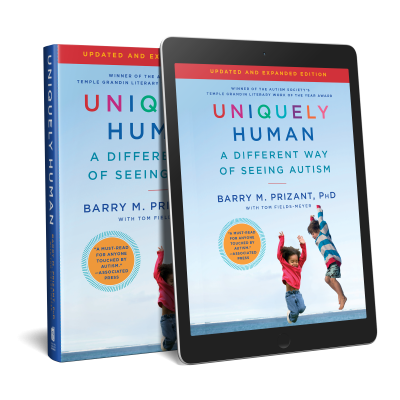
Uniquely Human, the book (Updated and Expanded edition!)
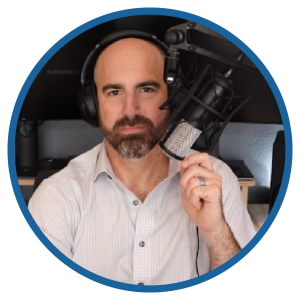
Dave Finch
Dave Finch is the author of the New York Times bestselling memoir, The Journal of Best Practices: A Memoir of Marriage, Asperger Syndrome, and One Man’s Quest to Be a Better Husband. As a writer and creative consultant, his work has appeared on ABC, CBS, NBC, CNN, NPR, SiriusXM, The New York Times, Rolling Stone, The Howard Stern Show, and the award-winning Netflix series, Atypical. Based in Denver, Dave’s company, Elevated Studio, produces this podcast and other recognized series.
Visit Dave’s website here
“I have read a million and one books on Autism. Uniquely Human is the best book I have ever read, hands down. Thank you Barry for this incredible gift!!!!”
– Navah Paskovitz, Mother of three boys with Autism, Co-Founder, the Ed Asner Family Center
“Compassion, learning and supportive strategies–the three essentials for working with folks with ASD–are an integral part of this must-read book.”
– Michelle Garcia Winner, Speech Language Pathologist and Founder of Social Thinking
“Thanks be to Barry for the first-ever must read written for parents, educators, and clinicians.”
– Michael John Carley, Founder, GRASP; Author of Asperger’s From the Inside-Out

“What makes the book compelling is how funny Mr. Finch is about himself. He’s great company.”
– Susannah Meadows, The New York Times
“In this hilarious memoir (which also gives some of the finest explications of Asperger’s out there), Finch approaches trying to be a better husband and father with the determination of Sherman marching on Atlanta.”
– Judith Newman, People (4/4 stars)
“Talk about being on a roll. This dude wrote a book, he has Asperger’s syndrome. He cured himself by listening to me on the radio!”
– Howard Stern